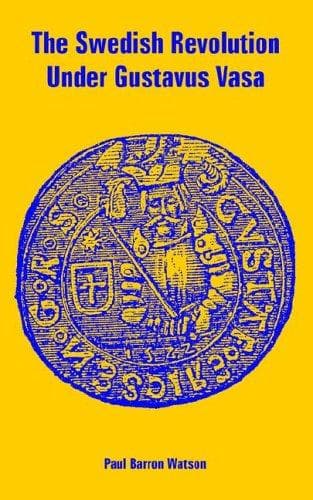
The Swedish Revolution Under Gustavus VasaWatson, Paul Barron
History
The Swedish Revolution Under Gustavus Vasa
Watson, Paul Barron
Gustav I Vasa, King of Sweden, 1496-1560; Sweden -- History -- Gustav I Vasa, 1523-1560
On the 21st of February, 1524, Laurentius Andreæ returned to the assault
with a long epistle to the Vadstena Chapter. This epistle is moderate in
tone, and contains this sound advice: "His Majesty desires that when you
discover strange doctrines in the books of Luther or of any other, you
should not reject them without a fair examination. If then you find
anything contrary to the truth, write a refutation of it based on Holy
Writ. As soon as scholars have seen your answer and have determined what
to accept and what reject, you can preach according to their judgment
and not according to your individual caprice. I suspect, however, there
will hardly be many among you able to refute these doctrines; for,
though but little of the so-called Lutheran teaching has come to my
knowledge, I am convinced that Luther is too great a man to be refuted
by simple men like us, for the Scriptures get their strength from no
man, but from God. Even if we have the truth on our side, 'tis folly for
us who have no arms to attack those who are well equipped, since we
should thus do nothing but expose our own simplicity.... Prove all
things; hold fast that which is good. Search the spirit to see whether
it be of God. I would urge every one to read the new doctrines. Those
who persuade or command you otherwise, appear to me to act contrary to
the Scriptures, and I suspect they do not wish the truth to come to
light.... If there be any among you whom this letter offends, let him
write to me, pointing out where I am wrong, and I will withdraw my
statements." Brask, though offended deeply, scorned the challenge.
Instead of answering Andreæ, he wrote to the bishop of Skara, saying:
"Certain persons are beginning to urge that we should not banish
Luther's writings, but should study them carefully to the end that we
may write against them, as if, forsooth, we were simple enough to
trouble ourselves about the effrontery of Luther. He flatters himself
that he possesses greater wisdom than all the saints. But we shall bow
the knee to God, not man, and shall do our utmost that the kingdom be
not corrupted by this new heresy." Brask was now boiling with
indignation, and a few days later wrote a friend: "I have no fear of
Luther or any other heretic. Were an angel from heaven to predict his
victory, I should not waver."[103]
Public-domain text, read in full here on John Shaqi.
Reviews
Reviews
No reviews yet
Be the first to share your thoughts on this work.
Elsewhere in the archive
Join the Discussion
Join the discussion
Sign in to leave a comment or review.
Sign InorCreate an account