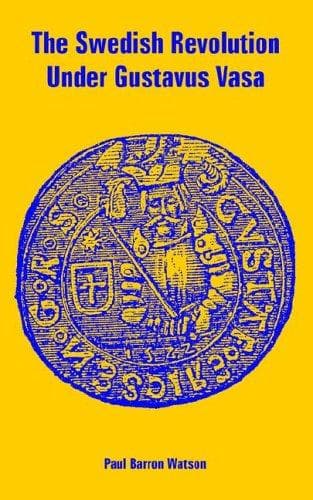
The Swedish Revolution Under Gustavus VasaWatson, Paul Barron
History
The Swedish Revolution Under Gustavus Vasa
Watson, Paul Barron
Gustav I Vasa, King of Sweden, 1496-1560; Sweden -- History -- Gustav I Vasa, 1523-1560
[74] July 13, 1523, a payment of about 17,000 marks having been already
made, Gustavus wrote to Brask that Lubeck still demanded 200,000
guilders, which was equivalent to about 300,000 Swedish marks. This
probably was an exaggeration for the purpose of getting a generous
contribution from Brask. Another source states it as more than 120,000
Swedish marks. Svart, _Gust. I.'s krön._, p. 72. This clearly was too
low an estimate; for we know that Gustavus paid at least 42,945 Lubeck
marks (or 83,000 Swedish marks) in the course of 1523, and that in the
following spring the amount claimed by Lubeck was about 240,000 Swedish
marks. See _Kon. Gust. den Förstes registrat._, vol. i. pp. 109-110, and
the documents in the Archives at Lubeck cited in Handelmann's _Die
letzten Zeiten der hanseatischen Uebermacht im Norden_, pp. 165-170. The
matter is ably discussed by Forssell in his _Sver. inre hist._, vol. i.
pp. 134-138. Much confusion is caused by the fact that the debtor and
creditor reckoned the sum each according to his own monetary standard,
and there can be no question, too, that between the parties there was
some dispute as to the exact sum due.
[75] See a document in the Archives at Lubeck cited in Handelmann's _Die
letzten Zeiten der hanseatischen Uebermacht im Norden_, p. 165.
[76] [Illustration]
Svart, _Gust. I.'s krön._, pp. 64-65. Svart, whose chronicle was written
with a view to flatter Gustavus, informs us of the reduction in the
value at which the coin was issued, and appears to attribute this
reduction to the generosity of his master. It was "a good fat coin," he
adds, which merchants carried out of the country as an excellent piece
of merchandise. The zeal with which the chronicler defends the coin is
enough to raise suspicion as to its true value. If it was really worth
an öre and a half, it is incredible that Gustavus in the strait in which
he then was should have ultimately given it for an öre. Forssell, in his
_Anteckn. om mynt, vigt, mått och varupris i Sverige_, pp. 44-51,
suggests that probably the coin was first issued for an öre and a half,
and then with the same size and weight but containing more alloy, was
issued for an öre. I think the true explanation is more simple. Gustavus
had been found out. The "klippings" which he had issued a year before
were such a palpable fraud that the Danish commandant of Stockholm had
actually forbidden their use, lest the Danish "klippings" (which were
about as bad as anything could be) might through association with the
others fall into ill repute. _Christ. II.'s arkiv_, vol. i. pp. 214 and
218. So that when he issued a new coin and called it an öre and a half,
people were suspicious and refused to take it till he reduced it to
something like its value. This view is strengthened by the fact that of
the few extant coins of Gustavus, dated 1522, not one contains enough
silver to have been worth an öre and a half, and most of them fall
considerably below the value of an öre.
Public-domain text, read in full here on John Shaqi.
Reviews
Reviews
No reviews yet
Be the first to share your thoughts on this work.
Elsewhere in the archive
Join the Discussion
Join the discussion
Sign in to leave a comment or review.
Sign InorCreate an account