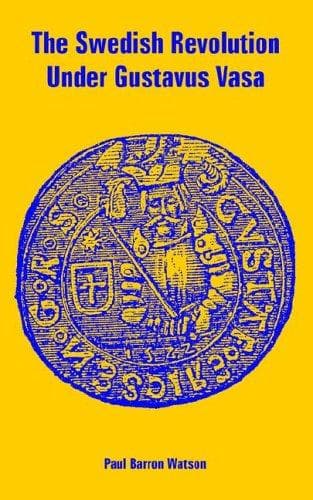
The Swedish Revolution Under Gustavus VasaWatson, Paul Barron
History
The Swedish Revolution Under Gustavus Vasa
Watson, Paul Barron
Gustav I Vasa, King of Sweden, 1496-1560; Sweden -- History -- Gustav I Vasa, 1523-1560
Gustavus now learned definitely that Norby, ever since his fleet left
Gotland, had been in secret conspiracy with Mehlen. He determined,
therefore, that, since the pirate had gained a foothold on the mainland,
Kalmar must be secured at any risk. So he collected men from every
quarter and sent them down to Kalmar to reinforce the town. Some few
weeks later, as the castle had not yielded, he proceeded to the town
himself. The burghers, hoping the conflict would now be ended, welcomed
him with joy. But the garrison still believed in Mehlen, and confidently
awaited his return with aid. Gustavus sent an envoy to the castle, to
persuade the garrison to yield. The answer was, the garrison would not
be yielded till every one of them was dead. But one course, therefore,
was open to the monarch,--the castle must be stormed. This, with the
guns which he possessed, demanded almost more than human strength. The
castle was surrounded on all sides by a moat, beyond which rose a
perpendicular wall of masonry twenty feet in height. This rampart was
washed on three sides by the sea, and on the other was protected by a
broad deep dike and then an outer wall. From within, the rampart was
guarded by eight huge towers that stood out from the castle-walls, and
the four corners of the ramparts were further strengthened by four more
towers with apertures for crossbows, cannon, and muskets. Such was the
fortress that Gustavus, late in July, resolved to storm. He began by
throwing up a line of earthworks, behind which he placed his heavy guns,
hoping to batter down the towers and ramparts, while his pikemen and
halberdiers were scaling the unprotected parts. But his men at first
were lukewarm. The task seemed herculean, and every effort to ascend the
ramparts met with certain death. Those in the castle fought like
maniacs, the men with guns and crossbows, and the women firing stones.
Gustavus, it is reported, stormed and swore, and finally put on his
armor, declaring that he would either have the castle or die within its
walls. His enthusiasm spread among his men, and they shouted they would
do their best, though every man of them should fall. The effect was
visible at once. Each charge left the ramparts weaker than before; and
when night closed in, there was not a tower or rampart whole. The next
morning, when Gustavus turned his culverins again upon the wall, the
flag of truce was raised. The garrison hoped that if they sued before
the ramparts actually fell, they might be granted favorable terms. But
the monarch, who had now lost nearly half his men, demanded an
unconditional surrender. As Norby had been conquered, and no signs of
Mehlen's succor had appeared, the garrison, after much palaver, threw
themselves upon the mercy of the king. The castle, on the 20th of July,
passed into the monarch's hands once more, and a large portion of the
rebel garrison was put to death. With this scene the conspiracy of
Norby, Mehlen, and their adherents was at an end.[121]
Public-domain text, read in full here on John Shaqi.
Reviews
Reviews
No reviews yet
Be the first to share your thoughts on this work.
Elsewhere in the archive
Join the Discussion
Join the discussion
Sign in to leave a comment or review.
Sign InorCreate an account