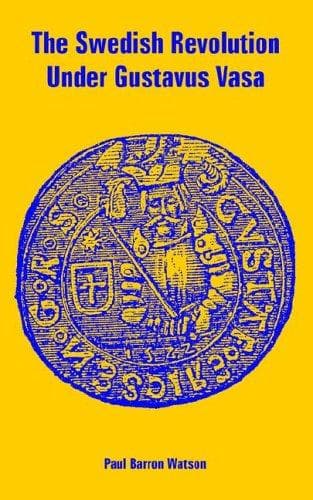
The Swedish Revolution Under Gustavus VasaWatson, Paul Barron
History
The Swedish Revolution Under Gustavus Vasa
Watson, Paul Barron
Gustav I Vasa, King of Sweden, 1496-1560; Sweden -- History -- Gustav I Vasa, 1523-1560
nothing,--and that Lubeck had written to demand immediate payment of the
whole. "Her envoys have now closed our doors so tight that it is hardly
possible for us to go out." It was clear that some new scheme must be
devised, and on the 23d of June the king applied to certain members of
his Cabinet. "We have now," he wrote, "as frequently before, had letters
from Lubeck demanding in curt language the payment of her debt. You are
aware that we have often, especially in Cabinet meetings, asked you to
suggest some mode of meeting this requirement, and have never yet been
able to elicit any tangible response. Indeed, you have not had the
matter much at heart, but have rather left it to be arranged by us. You
have, it is true, suggested that the tithes be used, but we find that,
though we much relied upon them, they are but a tittle. Our entire taxes
for last year, including iron, skins, butter, salmon, amounted to
somewhat over ten thousand marks. This sum, which would naturally be
used to pay the expenses of our court, has been handed over to pay the
debt. The tithes received, which we were assured would be a considerable
sum, are shown by our books not to have exceeded two thousand marks in
all. The treasury balance has now run so low that we have but a trifle
left, and our soldiers, who are now much needed to keep off Christiern
and Norby, must be paid. We therefore beg you take this matter seriously
to heart, and devise some means by which the debt may soon be paid....
It is utterly impossible from the taxes alone to keep an army and pay
this heavy debt, for the taxes are no greater than they were some years
ago, though the expenses are very much increased; and, moreover, we have
no mines to turn to, as our fathers had." This urgent appeal inspired
the Cabinet to act, and at a meeting held in August they provided that a
new tax be laid on every subject in the realm. In the table that
accompanied this Act, the amounts to be contributed by the different
provinces were accurately fixed, as well as the amounts to be collected
in the towns. The bishops, too, were called upon to furnish each his
quota, based upon an estimate of his means: the archbishop of Upsala
paying four thousand marks, the bishop of Åbo three thousand marks,
Linköping two thousand five hundred marks, Skara and Strengnäs each two
thousand marks, Vesterås one thousand marks, and Vexiö five hundred
marks. The amount imposed on Åbo seems unreasonably large, which is
probably to be accounted for by the fact that Åbo was not present at the
meeting. Brask, in writing to Åbo, told the bishop that his quota was
three thousand marks, but did not name to him the individual amounts to
be contributed by the other bishops. Gustavus, in a letter to the
members of his Cabinet in Finland, was even more unfair. He told them
that Åbo was to pay three thousand marks, and added that Linköping and
Skara were to pay the same. Brask's letter is particularly important in
Public-domain text, read in full here on John Shaqi.
Reviews
Reviews
No reviews yet
Be the first to share your thoughts on this work.
Elsewhere in the archive
Join the Discussion
Join the discussion
Sign in to leave a comment or review.
Sign InorCreate an account