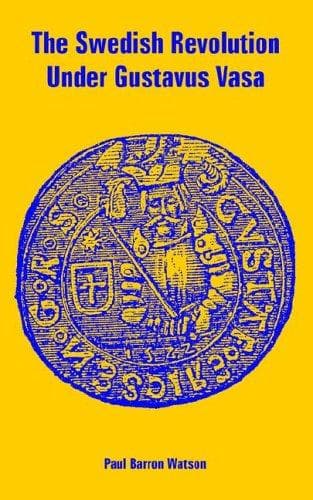
The Swedish Revolution Under Gustavus VasaWatson, Paul Barron
History
The Swedish Revolution Under Gustavus Vasa
Watson, Paul Barron
Gustav I Vasa, King of Sweden, 1496-1560; Sweden -- History -- Gustav I Vasa, 1523-1560
When the diet once more came together, the battle opened with
replenished strength. By this time the peasantry and burghers had pretty
generally sided with the king, and threats were heard that, if the
knights persisted in their stubborn purpose, they would be made to
suffer for it. This language proved more efficacious than persuasion.
The knights and bishops could agree upon no policy, nor upon a leader.
They were terrified, moreover, by the preponderance in number of their
foes. As a consequence, they gradually weakened, till at last the
delegates all voted to obey the monarch's will. Andreæ and Petri were
therefore chosen to approach Gustavus and inform him that the delegates
would now consent to his requests. Gustavus then indulged once more his
love of masquerade. He feigned reluctance to accept the proffered honor,
and scorned the delegates who came to him upon their knees. One after
another the recalcitrant members grovelled in the dust before him, and
begged that he would show them mercy. This was the sort of ceremony that
the monarch loved. He kept his enemies in their humble posture till his
vanity was glutted, and then declared that he would go before the diet
on the following day.[161]
Gustavus was at last in a position to dictate to the diet. The
opportunity for which he had been longing since his first acceptance of
the crown was now at hand. He had won an unconditional victory over
every one of his opponents, and he was minded to use this victory for
all that it was worth. It is matter of regret that practically no
account is given us of the steps by which the measures that he sought to
have enacted were attained. This very meagreness, however, is strong
evidence that the measures were enacted without much friction.
Apparently, the only object of the delegates now was to suit their
action to the monarch's will. They therefore adopted as their guiding
star the propositions with which the diet had been opened by the king,
and formulated a set of answers in conformity therewith. These answers
were drawn respectively by the Cabinet and nobility, by the burghers and
mountaineers, and by the common people. It is worthy of more than
passing notice that no answer was presented by the clergy. Indeed, the
clergy appear to have been regarded in the light of victims. The whole
object of the diet was to crush the Church, and the clergy were not
permitted even to have a hand in the proceedings. The monarch's notion
was to give the clergy no voice whatever in the diet, but after the lay
delegates had formulated their resolves, to force the bishops to issue a
proclamation certifying their assent.
Public-domain text, read in full here on John Shaqi.
Reviews
Reviews
No reviews yet
Be the first to share your thoughts on this work.
Elsewhere in the archive
Join the Discussion
Join the discussion
Sign in to leave a comment or review.
Sign InorCreate an account