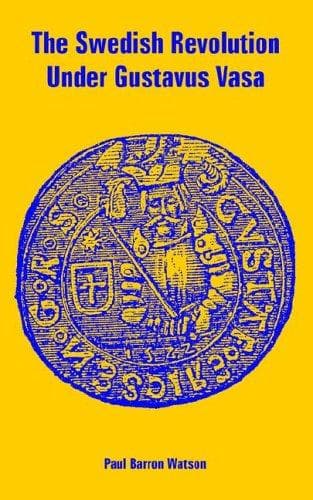
The Swedish Revolution Under Gustavus VasaWatson, Paul Barron
History
The Swedish Revolution Under Gustavus Vasa
Watson, Paul Barron
Gustav I Vasa, King of Sweden, 1496-1560; Sweden -- History -- Gustav I Vasa, 1523-1560
In Sweden, more than in almost any other land, the Reformation was a
political revolt. Indeed, it may well be called a political necessity.
At the moment when Gustavus Vasa was elected king, Sweden was on the
verge of bankruptcy. The war just passed had drained the resources of
the country, and left her heavily involved in debt. The principal
creditor was Lubeck. Precisely how much had been borrowed from that town
it is impossible to determine, though it is certain the total amount
fell not far short of 300,000 Swedish marks.[74] One payment of about
17,000 Swedish marks Gustavus had made in 1522.[75] This of course was a
mere drop in the bucket, and other devices were necessary to relieve the
general distress. One favorite device, to which allusion has been
already made, consisted in a debasement of the currency. That device,
however, had soon lost its savor, and the coin which in 1522 Gustavus
had issued for an öre and a half, he was forced in 1523 to place upon
the market as an öre.[76] So that when the new monarch ascended the
throne it was manifest that the treasury must be replenished in other
modes. The natural direction was that in which the greatest wealth of
Sweden lay,--in other words, the Church. We have already seen how
completely, in the centuries preceding the Reformation, the Church in
Sweden had freed herself from all authority of the people, and had
gradually accumulated for herself a vast amount of wealth. Some
conception of this treasure may be had by comparing the edifices
belonging to the Church with those owned by individuals. Such a
comparison reveals at once an enormous disparity in favor of the Church.
At a time when well-to-do citizens dwelt in what would at this day be
known as hovels, they worshipped in churches that must have seemed to
them palatial. The six cathedrals that existed in the time of Gustavus
still remain, and even at this day compare favorably with the finest
structures in the land. In addition to a magnificent palace, the
archbishop and the five Swedish bishops each possessed a fortified
castle in his diocese. In each diocese, too, there were an enormous
number of estates belonging to the bishopric; those in the diocese of
Linköping, for example, numbering over six hundred. The rents and
profits from these estates went directly to the bishopric, and were
wholly exempt from taxation, as were also the untold treasures of gold
and silver belonging to the various churches. Beside all this tithes of
every species of farm produce raised in any part of Sweden were due the
Church, also tithes of all other personal property acquired. Further, a
small annual tax was due the Church for every building in the land from
a palace to a pig-sty; also a fee for every wedding, death, or
childbirth. No one could inherit property, or even take the sacrament,
without a contribution to the Church. And every peasant was bound one
day each year to labor for his pastor without reward.[77] How all this
Public-domain text, read in full here on John Shaqi.
Reviews
Reviews
No reviews yet
Be the first to share your thoughts on this work.
Elsewhere in the archive
Join the Discussion
Join the discussion
Sign in to leave a comment or review.
Sign InorCreate an account