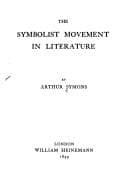
The Symbolist Movement in LiteratureSymons, Arthur
History
The Symbolist Movement in Literature
Symons, Arthur
French literature -- 19th century -- History and criticism; Symbolism (Literary movement) -- France
The old conception of the novel as an amusing tale of adventures,
though it has still its apologists in England, has long since ceased
in France to mean anything more actual than powdered wigs and lace
ruffles. Like children who cry to their elders for "a story, a story,"
the English public still wants its plot, its heroine, its villain.
That the novel should be psychological was a discovery as early as
Benjamin Constant, whose _Adolphe_ anticipates _Le Rouge et le Noir,_
that rare, revealing, yet somewhat arid masterpiece of Stendhal.
But that psychology could be carried so far into the darkness of
the soul, that the flaming walls of the world themselves faded to a
glimmer, was a discovery which had been made by no novelist before
Huysmans wrote _En Route._ At once the novel showed itself capable
of competing, on their own ground, with poetry, with the great
"confessions," with philosophy. _En Route_ is perhaps the first novel
which does not et out with the aim of amusing its readers. It offers
you no more entertainment than _Paradise Lost_ or the _Confessions_
of St. Augustine, and it is possible to consider it on the same
level. The novel, which, after having chronicled the adventures of
the Vanity Fairs of this world, has set itself with admirable success
to analyse the amorous and ambitious and money-making intelligence of
the conscious and practical self, sets itself at last to the final
achievement: the revelation of the sub-conscious self, no longer the
intelligence, but the soul. Here, then, purged of the distraction of
incident, liberated from the bondage of a too realistic conversation,
in which the aim had been to convey the very gesture of breathing
life, internalised to a complete liberty, in which, just because it is
so absolutely free, art is able to accept, without limiting itself,
the expressive medium of a convention, we have in the novel a new
form, which may be at once a confession and a decoration, the soul
and a pattern. This story of a conversion is a new thing in modern
French; it is a confession, a self-auscultation of the soul; a kind
of thinking aloud. It fixes, in precise words, all the uncertainties,
the contradictions, the absurd unreasonableness and not less absurd
logic, which distract man's brain in the passing over him of sensation
and circumstance. And all this thinking is concentrated on one end,
is concerned with the working out, in his own singular way, of one
man's salvation. There is a certain dry hard casuistry, a subtlety and
closeness almost ecclesiastical, in the investigation of an obscure and
yet definite region, whose intellectual passions are as varied and as
tumultuous as those of the heart. Every step is taken deliberately,
is weighed, approved, condemned, viewed from this side and from that,
and at the same time one feels behind all this reasoning an impulsion
urging a soul onward against its will. In this astonishing passage,
Public-domain text, read in full here on John Shaqi.
Reviews
Reviews
No reviews yet
Be the first to share your thoughts on this work.
Elsewhere in the archive
Join the Discussion
Join the discussion
Sign in to leave a comment or review.
Sign InorCreate an account