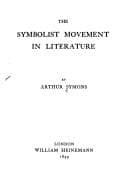
The Symbolist Movement in LiteratureSymons, Arthur
History
The Symbolist Movement in Literature
Symons, Arthur
French literature -- 19th century -- History and criticism; Symbolism (Literary movement) -- France
He was
transported first to Aden, then to Marseilles, where, in May, 1891, his
leg was amputated. Further complications set in. He insisted, first,
on being removed to his home, then on being taken back to Marseilles.
His sufferings were an intolerable torment, and more cruel to him was
the torment of his desire to live. He died inch by inch, fighting
every inch; and his sister's quiet narrative of those last months is
agonising. He died at Marseilles in November, "prophesying," says his
sister, and repeating, "Allah Kerim! Allah Kerim!"
The secret of Rimbaud, I think, and the reason why he was able to do
the unique thing in literature which he did, and then to disappear
quietly and become a legend in the East, is that his mind was not
the mind of the artist but of the man of action. He was a dreamer,
but all his dreams were discoveries. To him it was an identical act
of his temperament to write the sonnet of the _Vowels_ and to trade
in ivory and frankincense with the Arabs. He lived with all his
faculties at every instant of his life, abandoning himself to himself
with a confidence which was at once his strength and (looking at
things less absolutely) his weakness. To the student of success, and
what is relative in achievement, he illustrates the danger of one's
over-possession by one's own genius, just as aptly as the saint in the
cloister does, or the mystic too full of God to speak intelligibly to
the world, or the spilt wisdom of the drunkard. The artist who is above
all, things an artist cultivates a little choice corner of himself
with elaborate care; he brings miraculous flowers to growth there, but
the rest of the garden is but mown grass or tangled bushes. That is
why many excellent writers very many painters, and most musicians are
so tedious on any subject but their own. Is it not tempting, does it
not seem a devotion rather than a superstition, to worship the golden
chalice in which the wine has been made God, as if the chalice were the
reality, and the Real Presence the symbol? The artist, who is only an
artist, circumscribes his intelligence into almost such a fiction, as
he reverences the work of his own hands. But there are certain natures
(great or small, Shakespeare or Rimbaud, it makes no difference) to
whom the work is nothing; the act of working, everything. Rimbaud was
a small, narrow, hard, precipitate nature, which had the will to live,
and nothing but the will to live; and his verses, and his follies,
and his wanderings, and his traffickings were but the breathing of
different hours in his day.
Public-domain text, read in full here on John Shaqi.
Reviews
Reviews
No reviews yet
Be the first to share your thoughts on this work.
Elsewhere in the archive
Join the Discussion
Join the discussion
Sign in to leave a comment or review.
Sign InorCreate an account