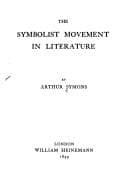
The Symbolist Movement in LiteratureSymons, Arthur
History
The Symbolist Movement in Literature
Symons, Arthur
French literature -- 19th century -- History and criticism; Symbolism (Literary movement) -- France
Maeterlinck has realised, better than any one else, the significance,
in life and art, of mystery. He has realised how unsearchable is the
darkness out of which we have but just stepped, and the darkness
into which we are about to pass. And he has realised how the thought
and sense of that twofold darkness invade the little space of light
in which, for a moment, we move; the depth to which they shadow our
steps, even in that moment's partial escape. But in some of his plays
he would seem to have apprehended this mystery as a thing merely or
mainly terrifying; the actual physical darkness sur-rounding blind men,
the actual physical approach of death as the intruder; he has shown
us people huddled at a window, out of which they are almost afraid
to look, or beating at a door, the opening of which they dread. Fear
shivers through these plays, creeping across our nerves like a damp
mist coiling up out of a valley. And there is beauty, certainly, in
this "vague spiritual fear"; but a less obvious kind of beauty than
that which gives its profound pathos to _Aglavaine et Sélysette,_ the
one play written since the writing of the essays. Here is mystery,
which is also pure beauty, in these delicate approaches of intellectual
pathos, in which suffering and death and error become transformed into
something almost happy, so full is it of strange light.
And the aim of Maeterlinck, in his plays, is not only to render the
soul and the soul's atmosphere, but to reveal this strangeness, pity,
and beauty through beautiful pictures. No dramatist has ever been so
careful that his scenes should be in themselves beautiful, or has
made the actual space of forest, tower, or seashore so emotionally
significant. He has realised, after Wagner, that the art of the stage
is the art of pictorial beauty, of the correspondence in rhythm between
the speakers, their words, and their surroundings. He has seen how, in
this way, and in this way alone, the emotion, which it is but a part of
the poetic drama to express, can be at once intensified and purified.
Public-domain text, read in full here on John Shaqi.
Reviews
Reviews
No reviews yet
Be the first to share your thoughts on this work.
Elsewhere in the archive
Join the Discussion
Join the discussion
Sign in to leave a comment or review.
Sign InorCreate an account