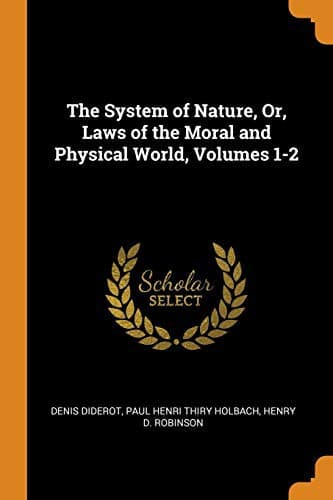
The System of Nature, or, the Laws of the Moral and Physical World. Volume 1Holbach, Paul Henri Thiry, baron d'
Religion
The System of Nature, or, the Laws of the Moral and Physical World. Volume 1
Holbach, Paul Henri Thiry, baron d'
Materialism; Philosophy and religion; Psychology
_Imagination_ is the faculty of combining with promptitude ideas or
images; it consists in the power man possesses of re-producing with ease
the modifications of his brain: of connecting them, of attaching them to
the objects to which they are suitable. When imagination does this, it
gives pleasure; its fictions are approved, it embellishes Nature, it
is a proof of the soundness of the mind, it aids truth: when on the
contrary, it combines ideas, not formed to associate themselves with
each other--when it paints nothing but disagreeable phantoms, it
disgusts, its fictions are censured, it distorts Nature, it advocates
falsehood, it is the proof of a disordered, of a deranged mind: thus
poetry, calculated to render Nature more pathetic, more touching,
pleases when it creates ideal beings, but which move us agreeably: we,
therefore, forgive the illusions it has held forth, on account of the
pleasure we have reaped from them. The hideous chimeras of superstition
displease, because they are nothing more than the productions of a
distempered imagination, that can only awaken the most afflicting
sensations, fills us with the most disagreeable ideas.
Imagination, when it wanders, produces fanaticism, superstitious
terrors, inconsiderate zeal, phrenzy, and the most enormous crimes: when
it is well regulated, it gives birth to a strong predilection for useful
objects, an energetic passion for virtue, an enthusiastic love of our
country, and the most ardent friendship: the man who is divested
of imagination, is commonly one in whose torpid constitution phlegm
predominates over the igneous fluid, over that sacred fire, which is
the great principle of his mobility, of that warmth of sentiment, which
vivifies all his intellectual faculties. There must be enthusiasm for
transcendent virtues as well as for atrocious crimes; enthusiasm places
the soul in a state similar to that of drunkenness; both the one and the
other excite in man that rapidity of motion which is approved, when
good results, when its effects are beneficial; but which is censured,
is called folly, delirium, crime, fury; when it produces nothing but
disorder and confusion.
Public-domain text, read in full here on John Shaqi.
Reviews
Reviews
No reviews yet
Be the first to share your thoughts on this work.
Elsewhere in the archive
Join the Discussion
Join the discussion
Sign in to leave a comment or review.
Sign InorCreate an account