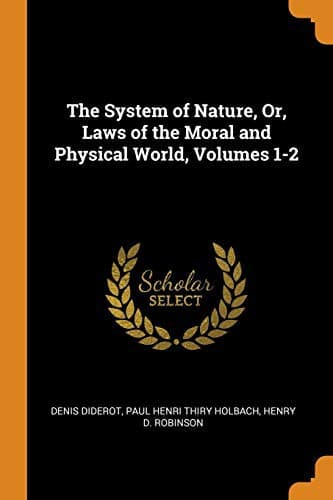
The System of Nature, or, the Laws of the Moral and Physical World. Volume 1Holbach, Paul Henri Thiry, baron d'
Religion
The System of Nature, or, the Laws of the Moral and Physical World. Volume 1
Holbach, Paul Henri Thiry, baron d'
Materialism; Philosophy and religion; Psychology
_Government_ has necessarily an equal influence over the philosophy, as
over the morals of nations. In the same manner that its care produces
labour, activity, abundance, salubrity and justice; its negligence
induces idleness, sloth, discouragement, penury, contagion, injustice,
vices and crimes. It depends upon government either to foster industry,
mature genius, give a spring to talents, or stifle them. Indeed
government, the disturber of dignities, of riches, of rewards, and
punishments; the master of those objects in which man from his infancy
has learned to place his felicity, and contemplate as the means of his
happiness; acquires a necessary influence over his conduct: it kindles
his passions; gives them direction; makes him instrumental to whatever
purpose it pleases; it modifies him; determines his manners; which in
a whole people, as in the individual, is nothing more than the conduct,
the general system of wills, of actions that necessarily result from his
education, government, laws, and religious opinions--his institutions,
whether rational or irrational. In short, manners are the habits of a
people: these are good whenever society draws from them true felicity
and solid happiness; they are bad, they are detestable in the eye of
reason, when the happiness of society does not spring from them; they
are unwholesome when they have nothing more in their favour than the
suffrage of time, and the countenance of prejudice which rarely
consults experience, which is almost ever at variance with good sense:
notwithstanding they may have the sanction of the law, custom, religion,
public opinion, or example, they may be unworthy and may be disgraceful,
provided society is in disorder; that crime abounds; that virtue shrinks
beneath the basilisk eye of triumphant vice; they may then be said to
resemble the UPAS, whose luxuriant yet poisonous foliage, the produce
of a rank soil, becomes more baneful to those who are submitted to
its vortex, in proportion as it extends its branches. If experience he
consulted, it will be found there is no action, however abominable, that
has not received the applause, that has not obtained the approbation of
some people. Parricide, the sacrifice of children, robbery, usurpation,
cruelty, intolerance, and prostitution, have all in their turn been
licensed actions; have been advocated; have been deemed laudable
and meritorious deeds with some nations of the earth. Above all,
_superstition_ has consecrated the most unreasonable, the most revolting
customs.
Public-domain text, read in full here on John Shaqi.
Reviews
Reviews
No reviews yet
Be the first to share your thoughts on this work.
Elsewhere in the archive
Join the Discussion
Join the discussion
Sign in to leave a comment or review.
Sign InorCreate an account