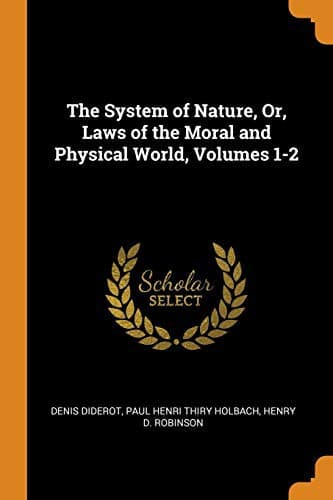
The System of Nature, or, the Laws of the Moral and Physical World. Volume 1Holbach, Paul Henri Thiry, baron d'
Religion
The System of Nature, or, the Laws of the Moral and Physical World. Volume 1
Holbach, Paul Henri Thiry, baron d'
Materialism; Philosophy and religion; Psychology
_Public opinion_ every instant offers to man's contemplation false ideas
of honor, and wrong notions of glory: it attaches his esteem not only
to frivolous advantages, but also to prejudicial interests and injurious
actions; which example authorizes, which prejudice consecrates, which
habit precludes him from viewing with the disgust and horror which they
merit. Indeed, habit familiarizes his mind with the most absurd
ideas, the most unreasonable customs, the most blameable actions; with
prejudices the most contrary to his own interests, and detrimental
to the society in which he lives. He finds nothing strange, nothing
singular, nothing despicable, nothing ridiculous, except those opinions
and objects to which he is himself unaccustomed. There are countries
in which the most laudable actions appear very blameable and
ridiculous--where the foulest and most diabolical actions pass for very
honest and perfectly rational conduct. In some nations they kill the old
men; in some the children strangle their fathers. The Phoenicians and
Carthaginians immolated their children to their gods. Europeans approve
duels; he who refuses to cut the throat of another, or to blow out the
brains of his neighbour, is contemplated by them as dishonoured. The
Spaniards and Portuguese think it meritorious to burn an heretic. In
some countries women prostitute themselves without dishonour; in others
it is the height of hospitality for a man to present his wife to the
embraces of the stranger: the refusal to accept this, excites his scorn
and calls forth his resentment.
_Authority_ commonly believes itself interested in maintaining the
received opinions: those prejudices and errors which it considers
requisite to the maintenance of its power and the consolidation of its
interests, are sustained by force, which is never rational. Princes
themselves, filled with deceptive images of happiness, mistaken notions
of power, erroneous opinions of grandeur, and false ideas of glory, are
surrounded with flattering courtiers, who are interested in keeping
up the delusion of their masters: these contemptible men have acquired
ideas of virtue, only that they may outrage it: by degrees they
corrupt the people, these become depraved, lend themselves to their
debaucheries, pander to the vices of the great, then make a merit of
imitating them in their irregularities. A court is too frequently the
true focus of the corruption of a people.
Public-domain text, read in full here on John Shaqi.
Reviews
Reviews
No reviews yet
Be the first to share your thoughts on this work.
Elsewhere in the archive
Join the Discussion
Join the discussion
Sign in to leave a comment or review.
Sign InorCreate an account