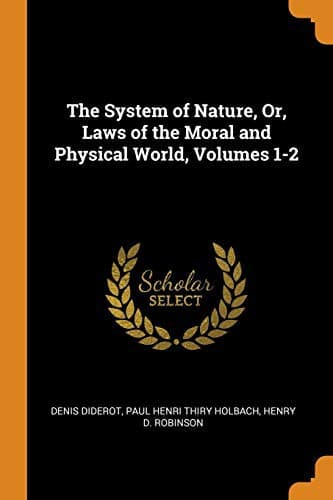
The System of Nature, or, the Laws of the Moral and Physical World. Volume 1Holbach, Paul Henri Thiry, baron d'
Religion
The System of Nature, or, the Laws of the Moral and Physical World. Volume 1
Holbach, Paul Henri Thiry, baron d'
Materialism; Philosophy and religion; Psychology
Nevertheless, to justify such monstrous opinions, they assert that ideas
are only the objects of thought. But according to the last analysis,
these ideas can only reach man from exterior objects, which in giving
impulse to his senses modify his brain; or from the material beings
contained within the interior of his machine, who make some parts of his
body experience those sensations which he perceives, which furnish him
with ideas, which he relates, faithfully or otherwise, to the cause that
moves him. Each idea is an effect, but however difficult it may be to
recur to the cause, can we possibly suppose it is not ascribable to
a cause? If we can only form ideas of material substances, how can we
suppose the cause of our ideas can possibly be immaterial? To pretend
that man without the aid of exterior objects, without the intervention
of his senses, is competent to form ideas of the universe, is to assert,
that a blind man is in a capacity to form a true idea of a picture, that
represents some fact of which he has never heard any one speak.
It is very easy to perceive the source of those errors, into which men,
otherwise extremely profound and very enlightened have fallen, when they
have been desirous to speak of the soul: to describe its operations.
Obliged either by their own prejudices, or by the fear of combatting the
opinions of some imperious theologian, they have become the advocates of
the principle, that the soul was a pure spirit: an immaterial substance;
of an essence directly different from that of the body; from every thing
we behold: this granted, they have been incompetent to conceive how
material objects could operate, in what manner gross and corporeal
organs were enabled to act on a substance, that had no kind of analogy
with them; how they were in a capacity to modify it by conveying its
ideas; in the impossibility of explaining this phenomenon, at the same
time perceiving that the soul had ideas, they concluded that it must
draw them from itself, and not from those beings, which according to
their own hypothesis, were incapable of acting on it, or rather, of
which they could not conceive the manner of action; they therefore
imagined that all the modifications, all the actions of this soul,
sprung from its own peculiar energy, were imprinted on it from its first
formation, by the Author of Nature: that these did not in any manner
depend upon the beings of which we have a knowledge, or which act upon
it, by the gross means of our senses.
Public-domain text, read in full here on John Shaqi.
Reviews
Reviews
No reviews yet
Be the first to share your thoughts on this work.
Elsewhere in the archive
Join the Discussion
Join the discussion
Sign in to leave a comment or review.
Sign InorCreate an account