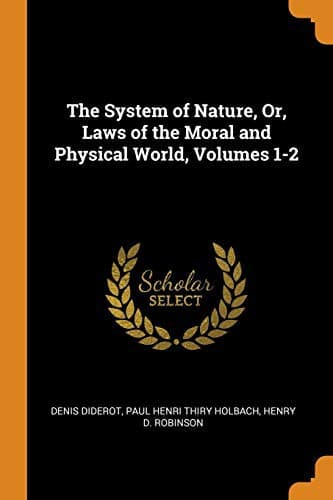
The System of Nature, or, the Laws of the Moral and Physical World. Volume 1Holbach, Paul Henri Thiry, baron d'
Religion
The System of Nature, or, the Laws of the Moral and Physical World. Volume 1
Holbach, Paul Henri Thiry, baron d'
Materialism; Philosophy and religion; Psychology
Indeed, it is never by any other means than by his senses, that
beings become known to man, or furnish him with ideas; it is only
in consequence of the impulse given to his body, that his brain is
modified, or that his soul thinks, wills, and acts. If, as ARISTOTLE
asserted more than two thousand years ago,--"_nothing enters the mind
of man but through the medium of his senses_,"--it follows as a
consequence, that every thing that issues from it must find some
sensible object to which it can attach its ideas, whether immediately,
as a man, a tree, a bird, &c. or in the last analysis or decomposition,
such as pleasure, happiness, vice, virtue, &c. This principle, so true,
so luminous, so important in its consequence, has been set forth in all
its lustre, by a great number of philosophers; among the rest, by the
great LOCKE. Whenever, therefore, a word or its idea does not connect
itself with some sensible object to which it can be related, this word
or this idea is unmeaning, and void of sense; it were better for man
that the idea was banished from his mind, struck out of his language:
this principle is only the converse of the axiom of ARISTOTLE,--"_if
the direct be evident, the inverse must be so likewise_." How has it
happened, that the profound LOCKE, who, to the great mortification
of the metaphysicians, has placed this principle of ARISTOTLE in the
clearest point of view? how is it, that all those who, like him, have
recognized the absurdity of the system of innate ideas, have not drawn
the immediate, the necessary consequences? How has it come to pass, that
they have not had sufficient courage to apply so clear a principle to
all those fanciful chimeras with which the human mind has for such a
length of time been so vainly occupied? did they not perceive that
their principle sapped the very foundations of those metaphysical
speculations, which never occupy man but with those objects of which, as
they are inaccessible to his senses, he consequently can never form
to himself any accurate idea? But prejudice, when it is generally held
sacred, prevents him from seeing the most simple application of the most
self-evident principles. In metaphysical researches, the greatest men
are frequently nothing more than children, who are incapable of either
foreseeing or deducing the consequence of their own data.
Public-domain text, read in full here on John Shaqi.
Reviews
Reviews
No reviews yet
Be the first to share your thoughts on this work.
Elsewhere in the archive
Join the Discussion
Join the discussion
Sign in to leave a comment or review.
Sign InorCreate an account