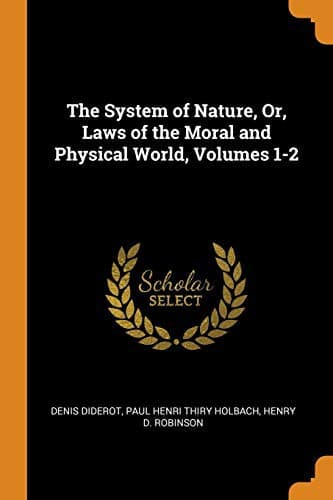
The System of Nature, or, the Laws of the Moral and Physical World. Volume 1Holbach, Paul Henri Thiry, baron d'
Religion
The System of Nature, or, the Laws of the Moral and Physical World. Volume 1
Holbach, Paul Henri Thiry, baron d'
Materialism; Philosophy and religion; Psychology
All the errors, all the disputes of men, have their foundation in this,
that they have renounced experience, have surrendered the evidence of
their senses, to give themselves up to the guidance of notions which
they have believed infused or innate; although in reality they are no
more than the effect of a distempered imagination, of prejudices, in
which they have been instructed from their infancy, with which habit
has familiarized them, which authority has obliged them to conserve.
Languages are filled with abstract words, to which are attached confused
and vague ideas; of which, when they come to be examined, no model can
be found in Nature; no object to which they can be related. When man
gives himself the trouble to analyze things, he is quite surprised to
find, that those words which are continually in the mouths of men,
never present any fixed or determinate idea: he hears them unceasingly
speaking of spirits--of the soul and its faculties--of duration--of
space--of immensity--of infinity--of perfection--of virtue--of
reason--of sentiment--of instinct--of taste, &c. without his being
able to tell precisely, what they themselves understand by these words.
Nevertheless, they do not appear to have been invented, but for the
purpose of representing the images of things; or to paint, by the
assistance of the senses, those known objects on which the mind is able
to meditate, which it is competent to appreciate, to compare, and to
judge.
For man to think of that which has not acted on any of his senses, is to
think on words; it is for his senses to dream; it is to seek in his own
imagination for objects to which he can attach his wandering ideas: to
assign qualities to these objects is, unquestionably, to redouble his
extravagance, to set no limits to his folly. If a word be destined to
represent to him an object that has not the capacity to act on any one
of his organs; of which, it is impossible for him to prove either the
existence or the qualities; his imagination, by dint of racking itself,
will nevertheless, in some measure, supply him with the ideas he wants;
he composes some kind of a picture, with the images or colours he is
always obliged to borrow, from the objects of which he has a knowledge:
thus the Divinity has been represented by some under the character of
a venerable old man; by others, under that of a puissant monarch; by
others, as an exasperated, irritated being, &c. It is evident, however,
that man, with some of his qualities, has served for the model of these
pictures: but if he be informed of objects that are represented as pure
spirits--that have neither body nor extent--that are not contained in
space--that are beyond nature,--here then he is plunged into emptiness;
his mind no longer has any ideas--it no longer knows upon what it
meditates. This, as will be seen in the sequel, no doubt, is the source
of those unformed notions which some men have formed of the Divinity;
Public-domain text, read in full here on John Shaqi.
Reviews
Reviews
No reviews yet
Be the first to share your thoughts on this work.
Elsewhere in the archive
Join the Discussion
Join the discussion
Sign in to leave a comment or review.
Sign InorCreate an account