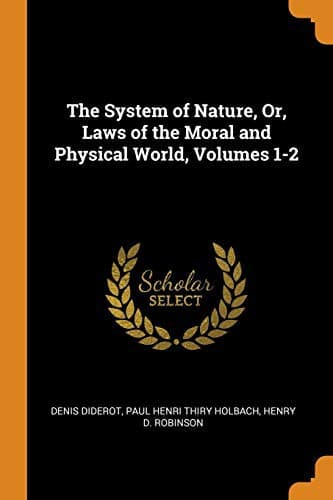
The System of Nature, or, the Laws of the Moral and Physical World. Volume 1Holbach, Paul Henri Thiry, baron d'
Religion
The System of Nature, or, the Laws of the Moral and Physical World. Volume 1
Holbach, Paul Henri Thiry, baron d'
Materialism; Philosophy and religion; Psychology
From this it must be evident, of what importance it is to _morals_ to
examine the ideas, to which it has been agreed to attach so much worth;
to which man is continually sacrificing his own peculiar happiness; to
which he is immolating the tranquillity of nations, at the irrational
command of fanatical cruel guides. Let him fall back on his experience;
let him return to Nature; let him occupy himself with reason; let him
consult those objects that are real, which are useful to his permanent
felicity; let him study Nature's laws; let him study himself; let him
consult the bonds which unite him to his fellow mortals; let him examine
the fictitious bonds that enchain him to the most baneful prejudices.
If his imagination must always feed itself with illusions, if he remains
steadfast in his own opinions, if his prejudices are dear to him, let
him at least permit others to ramble in their own manner, or seek after
truth as best suits their inclination; but let him always recollect,
that all the opinions--all the ideas--all the systems--all the
wills--all the actions of man, are the necessary consequence of his
nature, of his temperament, of his organization, and of those causes,
either transitory or constant, which modify hint: in short, that _man is
not more a free agent to think than to act:_ a truth that will be again
proved in the following chapter.
CHAP. XI
_Of the System of Man's free agency._
Those who have pretended that the _soul_ is distinguished from the body,
is immaterial, draws its ideas from its own peculiar source, acts by its
own energies without the aid of any exterior object; by a consequence
of their own system, have enfranchised it from those physical laws,
according to which all beings of which we have a knowledge are obliged
to act. They have believed that the foul is mistress of its own conduct,
is able to regulate its own peculiar operations; has the faculty to
determine its will by its own natural energy; in a word, they have
pretended man is a _free agent_.
Public-domain text, read in full here on John Shaqi.
Reviews
Reviews
No reviews yet
Be the first to share your thoughts on this work.
Elsewhere in the archive
Join the Discussion
Join the discussion
Sign in to leave a comment or review.
Sign InorCreate an account