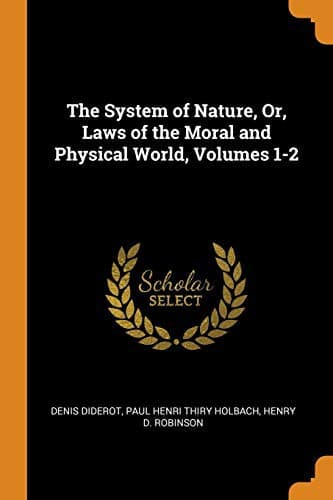
The System of Nature, or, the Laws of the Moral and Physical World. Volume 1Holbach, Paul Henri Thiry, baron d'
Religion
The System of Nature, or, the Laws of the Moral and Physical World. Volume 1
Holbach, Paul Henri Thiry, baron d'
Materialism; Philosophy and religion; Psychology
It is said that free-agency is the absence of those obstacles competent
to oppose themselves to the actions of man, or to the exercise of his
faculties: it is pretended that he is a free agent, whenever, making use
of these faculties, he produces the effect he has proposed to himself.
In reply to this reasoning, it is sufficient to consider that it in no
wise depends upon himself to place or remove the obstacles that either
determine or resist him; the motive that causes his action is no more in
his own power than the obstacle that impedes him, whether this obstacle
or motive be within his own machine or exterior of his person: he is not
master of the thought presented to his mind which determines his will;
this thought is excited by some cause independent of himself.
To be undeceived on the system of his free-agency, man has simply to
recur to the motive by which his will is determined, he will always find
this motive is out of his own controul. It is said, that in consequence
of an idea to which the mind gives birth, man acts freely if he
encounters no obstacle. But the question is, what gives birth to this
idea in his brain? has he the power either to prevent it from presenting
itself, or from renewing itself in his brain? Does not this idea
depend either upon objects that strike him exteriorly and in despite of
himself, or upon causes that without his knowledge act within himself
and modify his brain? Can he prevent his eyes, cast without design upon
any object whatever, from giving him an idea of this object, from
moving his brain? He is not more master of the obstacles; they are the
necessary effects of either interior or exterior causes, which always
act according to their given properties. A man insults a coward, who is
necessarily irritated against his insulter, but his will cannot vanquish
the obstacle that cowardice places to the object of his desire, which
is, to resent the insult; because his natural conformation, which does
not depend upon himself, prevents his having courage. In this case
the coward is insulted in despite of himself, and against his will is
obliged patiently to brook the insult he has received.
The partizans of the system of free-agency appear ever to have
confounded constraint with necessity. Man believes he acts as a free
agent, every time he does not see any thing that places obstacles to his
actions; he does not perceive that the motive which causes him to will
is always necessary, is ever independent of himself. A prisoner loaded
with chains is compelled to remain in prison, but he is not a free
agent, he is not able to resist the desire to emancipate himself;
his chains prevent him from acting, but they do not prevent him from
willing; he would save himself if they would loose his fetters, but he
would not save himself as a free agent, fear or the idea of punishment
would be sufficient motives for his action.
Public-domain text, read in full here on John Shaqi.
Reviews
Reviews
No reviews yet
Be the first to share your thoughts on this work.
Elsewhere in the archive
Join the Discussion
Join the discussion
Sign in to leave a comment or review.
Sign InorCreate an account