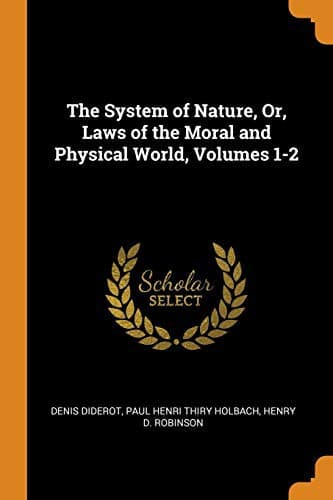
The System of Nature, or, the Laws of the Moral and Physical World. Volume 1Holbach, Paul Henri Thiry, baron d'
Religion
The System of Nature, or, the Laws of the Moral and Physical World. Volume 1
Holbach, Paul Henri Thiry, baron d'
Materialism; Philosophy and religion; Psychology
evil, which are true as they are necessary: instead of this, they search
for it in human nature, say it is corrupt, blame man for loving himself,
and for seeking after his own happiness, insist that he must have
supernatural assistance, some marvellous interference, to enable him to
become good: this is a very prejudicial doctrine for him, it is directly
subversive of his true happiness; by teaching him to hold himself in
contempt, it tends necessarily to discourage him; it either makes him
sluggish, or drives him to despair whilst waiting for this grace: is it
not easy to be perceived, that he would always have it if he was well
educated; if he was honestly governed? There cannot well exist a
wilder or a stranger system of morals, than that of the theologians who
attribute all moral evil to an original sin, and all moral good to the
pardon of it. It ought not to excite surprise if such a system is of no
efficacy; what can reasonably be the result of such an hypothesis? Yet,
notwithstanding the supposed, the boasted free-agency of man, it
is insisted that nothing less than the Author of Nature himself is
necessary to destroy the wicked desires of his heart: but, alas! no
power whatever is found sufficiently efficacious to resist those unhappy
propensities, which, under the fatal constitution of things, the most
vigorous motives, as before observed, are continually infusing into
the will of man; no agency seems competent to turn the course of that
unhappy direction these are perpetually giving to the stream of his
natural passions. He is, indeed, incessantly exhorted to resist these
passions, to stifle them, and to root them out of his heart; but is it
not evident they are necessary to his welfare? Can it not be perceived
they are inherent in his nature? Does not experience prove them to be
useful to his conservation, since they have for object, only to avoid
that which may be injurious to him; to procure that which may be
advantageous to his mode of existence? In short, is it not easy to
be seen, that these passions, well directed, that is to say, carried
towards objects that are truly useful, that are really interesting
to himself, which embrace the happiness of others, would necessarily
contribute to the substantial, to the permanent well-being of society?
Theologians themselves have felt, they have acknowledged the necessity
of the passions: many of the fathers of the church have broached this
doctrine; among the rest Father Senault has written a book expressly on
the subject: the passions of man are like fire, at once necessary to
the wants of life, suitable to ameliorate the condition of humanity,
and equally capable of producing the most terrible ravages, the most
frightful devastation.
Public-domain text, read in full here on John Shaqi.
Reviews
Reviews
No reviews yet
Be the first to share your thoughts on this work.
Elsewhere in the archive
Join the Discussion
Join the discussion
Sign in to leave a comment or review.
Sign InorCreate an account