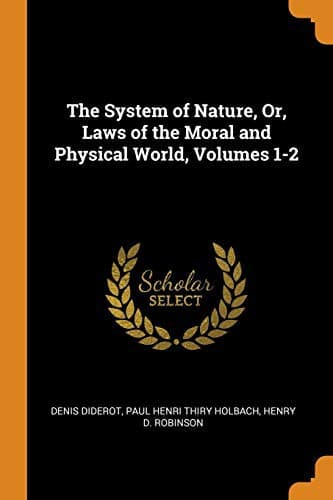
The System of Nature, or, the Laws of the Moral and Physical World. Volume 1Holbach, Paul Henri Thiry, baron d'
Religion
The System of Nature, or, the Laws of the Moral and Physical World. Volume 1
Holbach, Paul Henri Thiry, baron d'
Materialism; Philosophy and religion; Psychology
If he understood the play of his organs, if he was able to recal to
himself all the impulsions they have received, all the modifications
they have undergone, all the effects they have produced, he would
perceive, that all his actions are submitted to that _fatality_ which
regulates his own particular system, as it does the entire system of the
universe: no one effect in him, any more than in Nature, produce itself
by _chance_; this, as has been before proved, is a word void of sense.
All that passes in him, all that is done by him, as well as all that
happens in Nature, or that is attributed to her, is derived from
necessary laws, which produce necessary effects; from whence necessarily
flow others.
_Fatality_ is the eternal, the immutable, the necessary order
established in Nature, or the indispensible connection of causes that
act with the effects they operate. Conforming to this order, heavy
bodies fall, light bodies rise; that which is analogous in matter,
reciprocally attracts; that which is heterogeneous, mutually repels; man
congregates himself in society, modifies each his fellow, becomes either
virtuous or wicked; either contributes to his mutual happiness, or
reciprocates his misery; either loves his neighbour, or hates his
companion necessarily; according to the manner in which the one acts
upon the other. From whence it may be seen, that the same necessity
which regulates the physical, also regulates the moral world: in which
every thing is in consequence submitted to fatality. Man, in running
over, frequently without his own knowledge, often in despite of himself,
the route which Nature has marked out for him, resembles a swimmer who
is obliged to follow the current that carries him along; he believes
himself a free agent, because he sometimes consents, sometimes does
not consent, to glide with the stream; which, notwithstanding, always
hurries him forward; he believes himself the master of his condition,
because he is obliged to use his arms under the fear of sinking.
The false ideas he has formed to himself upon free-agency, are
in general thus founded: there are certain events which he judges
_necessary_; either because he sees they are effects that are
constantly, are invariably linked to certain causes, which nothing seems
to prevent; or because he believes he has discovered the chain of causes
and effects that is put in play to produce those events: whilst he
contemplates as _contingent_, other events, of whose causes he is
ignorant; the concatenation of which he does not perceive; with whose
mode of acting he is unacquainted: but in Nature, where every thing is
connected by one common bond, there exists no effect without a cause. In
the moral as well as in the physical world, every thing that happens is
a necessary consequence of causes, either visible or concealed; which
are, of necessity, obliged to act after their peculiar essences.
_In man, free-agency is nothing more than necessity contained within
himself_.
Public-domain text, read in full here on John Shaqi.
Reviews
Reviews
No reviews yet
Be the first to share your thoughts on this work.
Elsewhere in the archive
Join the Discussion
Join the discussion
Sign in to leave a comment or review.
Sign InorCreate an account