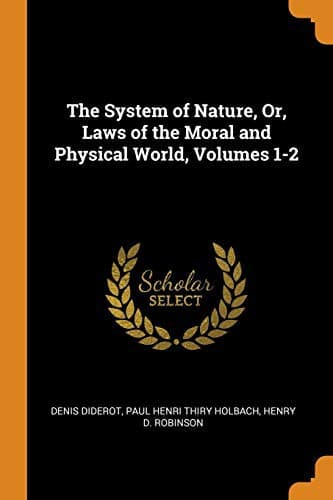
The System of Nature, or, the Laws of the Moral and Physical World. Volume 1Holbach, Paul Henri Thiry, baron d'
Religion
The System of Nature, or, the Laws of the Moral and Physical World. Volume 1
Holbach, Paul Henri Thiry, baron d'
Materialism; Philosophy and religion; Psychology
He never feels either shame or remorse
for actions he sees approved, that are practised by the world.
Under corrupt governments, venal souls, avaricious being, mercenary
individuals, do not blush either at meanness, robbery, or rapine, when
it is authorized by example; in licentious nations, no one blushes
at adultery except the husband, at whose expence it is committed; in
superstitious countries, man does not blush to assassinate his fellow
for his opinions. It will be obvious, therefore, that his remorse, as
well as the ideas, whether right or wrong, which man has of decency,
virtue, justice, &c. are the necessary consequence of his temperament,
modified by the society in which he lives: assassins and thieves, when
they live only among themselves, have neither shame nor remorse.
Thus, I repeat, all the actions of man are necessary those which are
always useful, which constantly contribute to the real, tend to the
permanent happiness of his species, are called _virtues_, and are
necessarily pleasing to all who experience their influence; at least,
if their passions or false opinions do not oblige them to judge in that
manner which is but little accordant with the nature of things: each man
acts, each individual judges, necessarily, according to his own peculiar
mode of existence--after the ideas, whether true or false, which he has
formed with regard to his happiness. There are necessary actions
which man is obliged to approve; there are others, that, in despite of
himself, he is compelled to censure; of which the idea generates shame
when his reflection permits him to contemplate them under the same point
of view that they are regarded by his associates. The virtuous man and
the wicked man act from motives equally necessary: they differ simply in
their organization--in the ideas they form to themselves of happiness:
we love the one necessarily--we detest the other from the same
necessity. The law of his nature, which wills that a sensible being
shall constantly labour to preserve himself, has not left to man the
power to choose, or the free-agency to prefer pain to pleasure--vice to
utility--crime to virtue. It is, then, the essence of man himself that
obliges him to discriminate those actions which are advantageous to him,
form those which are prejudicial to his interest, from those which are
baneful to his felicity.
Public-domain text, read in full here on John Shaqi.
Reviews
Reviews
No reviews yet
Be the first to share your thoughts on this work.
Elsewhere in the archive
Join the Discussion
Join the discussion
Sign in to leave a comment or review.
Sign InorCreate an account