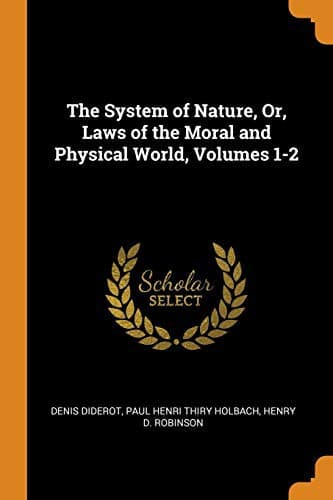
The System of Nature, or, the Laws of the Moral and Physical World. Volume 1Holbach, Paul Henri Thiry, baron d'
Religion
The System of Nature, or, the Laws of the Moral and Physical World. Volume 1
Holbach, Paul Henri Thiry, baron d'
Materialism; Philosophy and religion; Psychology
the Divinity; immortal, like the Godhead, in one part of himself:
nevertheless, subsequent religions have renounced these advantages,
which they judged incompatible with the other parts of their systems;
they held forth that the Sovereign of Nature, or her contriver was not
the soul of man, but, that, in virtue of his omnipotence, he created
human souls, in proportion as he produced the bodies which they must
animate; and they taught, that these souls once produced, by an effect
of the same omnipotence, enjoyed immortality.
However it may be with these variations upon the origin of souls, those
who supposed them emanating from the Divinity, believed that after the
death of the body, which served them for an envelope, they returned, by
refunding to their first source. Those who, without adopting the opinion
of divine emanation, admired the spirituality, believed the immortality
of the soul, were under the necessity to suppose a region, to find out
an abode for these souls, which their imagination painted to them, each
according to his fears, his hopes, his desires, and his prejudices.
Nothing is more popular than the doctrine of the _immortality of the
soul;_ nothing is more universally diffused than the expectation of
another life. Nature having inspired man with the most ardent love for
his existence, the desire of preserving himself for ever was a necessary
consequence; this desire was presently converted into certainty: from
that desire of existing eternally which Nature has implanted in him, he
made an argument, to prove that man would never cease to exist. Abady
says, "our soul has no useless desires, it naturally desires an eternal
life;" and by a very strange logic, he concludes that this desire
could not fail to be fulfilled. Cicero, before Abady, had declared the
immortality of the soul to be an innate idea in man; yet, strange
to tell, in another part of his works he considers Pherecydes as the
inventor of the doctrine. However this may be, man, thus disposed,
listened with avidity to those who announced to him systems so
conformable to his wishes. Nevertheless, he ought not to regard as
supernatural the desire of existing, which always was, and always will
be, of the essence man; it ought not to excite surprise, if he received
with eagerness an hypothesis that flattered his hopes, by promising
that his desire would one day be gratified; but let him beware how he
concludes that this desire itself is an indubitable proof of the reality
of this future life, with which at present he seems to be so much
occupied. The passion for existence is in man only a natural consequence
of the tendency of a sensible being, whose essence it is to be willing
to conserve himself: in the human being it follows the energy of his
soul--keeps pace with the force of his imagination--always ready to
realize that which he strongly desires. He desires the life of the body,
nevertheless this desire is frustrated; wherefore should not the desire
Public-domain text, read in full here on John Shaqi.
Reviews
Reviews
No reviews yet
Be the first to share your thoughts on this work.
Elsewhere in the archive
Join the Discussion
Join the discussion
Sign in to leave a comment or review.
Sign InorCreate an account