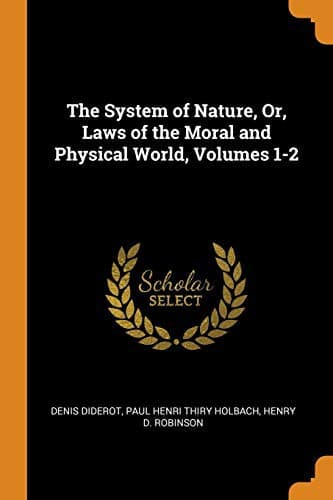
The System of Nature, or, the Laws of the Moral and Physical World. Volume 1Holbach, Paul Henri Thiry, baron d'
Religion
The System of Nature, or, the Laws of the Moral and Physical World. Volume 1
Holbach, Paul Henri Thiry, baron d'
Materialism; Philosophy and religion; Psychology
It will be seen then, that he who kills himself, does not, as it is
pretended, commit an outrage on nature. He follows an impulse which
has deprived him of reason; adopts the only means left him to quit his
anguish; he goes out of a door which she leaves open to him; he cannot
offend in accomplishing a law of necessity: the iron hand of this having
broken the spring that renders life desirable to him; which urged him to
self-conservation, shews him he ought to quit a rank or system where he
finds himself too miserable to have the desire of remaining. His country
or his family have no right to complain of a member, whom it has no
means of rendering happy; from whom consequently they have nothing more
to hope: to be useful to either, it is necessary he should cherish his
own peculiar existence; that he should have an interest in conserving
himself--that he should love the bonds by which he is united to
others--that he should be capable of occupying himself with their
felicity--that he should have a sound mind. That the suicide should
repent of his precipitancy, he should outlive himself, he should carry
with him into his future residence, his organs, his senses, his memory,
his ideas, his actual mode of existing, his determinate manner of
thinking.
In short, nothing is more useful for society, than to inspire man with
a contempt for death; to banish from his mind the false ideas he has of
its consequences. The fear of death can never do more than make
cowards; the fear of its consequences will make nothing but fanatics
or melancholy beings, who are useless to themselves, unprofitable to
others. Death is a resource that ought not by any means to be taken away
from oppressed virtue; which the injustice of man frequently reduces
to despair. If man feared death less, he would neither be a slave nor
superstitious; truth would find defenders more zealous; the rights of
mankind would be more hardily sustained; virtue would be intrepidly
upheld: error would be more powerfully opposed; tyranny would be
banished from nations: cowardice nourishes it, fear perpetuates it. In
fact, _man can neither be contented nor happy whilst his opinions shall
oblige him to tremble_.
CHAP. XV.
_Of Man's true Interest, or of the Ideas he forms to himself of
Happiness.--Man cannot be happy without Virtue._
Utility, as has been before observed, ought to be the only standard of
the judgment of man. To be useful, is to contribute to the happiness
of his fellow creatures; to be prejudicial, is to further their
misery. This granted, let us examine if the principles we have hitherto
established be prejudicial or advantageous, useful or useless, to the
human race. If man unceasingly seeks after his happiness, he can only
approve of that which procures for him his object, or furnishes him the
means by which it is to be obtained.
Public-domain text, read in full here on John Shaqi.
Reviews
Reviews
No reviews yet
Be the first to share your thoughts on this work.
Elsewhere in the archive
Join the Discussion
Join the discussion
Sign in to leave a comment or review.
Sign InorCreate an account