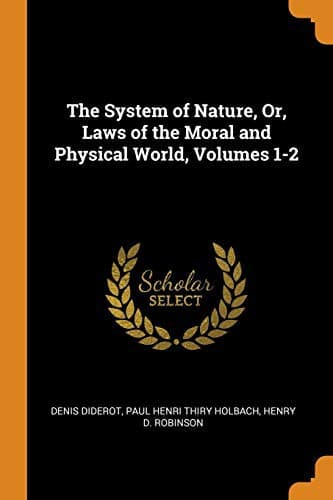
The System of Nature, or, the Laws of the Moral and Physical World. Volume 1Holbach, Paul Henri Thiry, baron d'
Religion
The System of Nature, or, the Laws of the Moral and Physical World. Volume 1
Holbach, Paul Henri Thiry, baron d'
Materialism; Philosophy and religion; Psychology
If man was perfectly contented, there would no longer be any activity in
the world; it is necessary that he should desire; it is requisite that
he should act; it is incumbent he should labour, in order that he may
be happy: such is the course of nature of which the life consists in
action. Human societies can only subsist, by the continual exchange of
those things in which man places his happiness. The poor man is obliged
to desire, he is necessitated to labour, that he may procure what he
knows is requisite to the preservation of his existence; the primary
wants given to him by nature, are to nourish himself, clothe himself,
lodge himself, and propagate his species; has he satisfied these? He
is quickly obliged to create others entirely new; or rather, his
imagination only refines upon the first; he seeks to diversify them; he
is willing to give them fresh zest; arrived at opulence, when he has run
over the whole circle of wants, when he has completely exhausted their
combinations, he falls into disgust. Dispensed from labour, his body
amasses humours; destitute of desires, his heart feels a languor;
deprived of activity, he is obliged to participate his riches, with
beings more active, more laborious than himself: these, following their
own peculiar interests, take upon themselves the task of labouring
for his advantage; of procuring for him means to satisfy his want;
of ministering to his caprices, in order to remove the languor that
oppresses him. It is thus the great, the rich excite the energies, give
play to the activity, rouse the faculties, spur on the industry of the
indigent; these labour to their own peculiar welfare by working for
others: thus the desire of ameliorating his condition, renders man
necessary to his fellow man; thus wants, always regenerating, never
satisfied, are the principles of life,--the soul of activity,--the
source of health,--the basis of society. If each individual was
competent to the supply of his own exigencies, there would be no
occasion for him to congregate in society; but it is his wants, his
desires, his whims, that place him in a state of dependence on others:
these are the causes that each individual, in order to further his
own peculiar interest, is obliged to be useful to those, who have the
capability of procuring for him the objects which he himself has not. A
nation is nothing more than the union of a great number of individuals,
connected with each other by the reciprocity of their wants; by their
mutual desire of pleasure. The most happy man is he who has the fewest
wants, and who has the most numerous means of satisfying them. The
man who would be truly rich, has no need to increase his fortune, it
suffices he should diminish his wants.
Public-domain text, read in full here on John Shaqi.
Reviews
Reviews
No reviews yet
Be the first to share your thoughts on this work.
Elsewhere in the archive
Join the Discussion
Join the discussion
Sign in to leave a comment or review.
Sign InorCreate an account