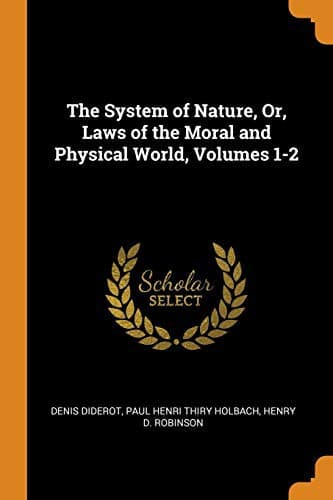
The System of Nature, or, the Laws of the Moral and Physical World. Volume 1Holbach, Paul Henri Thiry, baron d'
Religion
The System of Nature, or, the Laws of the Moral and Physical World. Volume 1
Holbach, Paul Henri Thiry, baron d'
Materialism; Philosophy and religion; Psychology
like his own, by the very food that satisfies them. The savage
needs only put forth his hand to gather the fruit that offers
itself spontaneously to his reach: this he finds sufficient for his
nourishment. The opulent citizen of a flourishing society is obliged to
set innumerable hands to work to produce the sumptuous repast; the four
quarters of the globe are ransacked to procure the far-fetched viands
become necessary to revive his languid appetite; the merchant,
the sailor, the mechanic, leave nothing unattempted to flatter his
inordinate vanity. From this it will appear, that in the same proportion
the wants of man are multiplied, he is obliged to augment the means to
satisfy them. Riches are nothing more than the measure of a convention,
by the assistance of which man is enabled to make a great number of
his fellows concur in the gratification of his desires; by which he
is capacitated to invite them, for their own peculiar interests, to
contribute to his pleasures. What, in fact, does the rich man do,
except announce to the needy, that he can furnish him with the means of
subsistence if he consents to lend himself to his will? What does the
man in power, except shew to others, that he is in a state to supply
the requisites to render them happy? Sovereigns, nobles, men of wealth,
appear to be happy, only because they possess the ability, are masters
of the motives sufficient to determine a great number of individuals to
occupy themselves with their respective felicity.
The more things are considered the more man will be convinced that his
false opinion are the true source of his misery; the clearer it will
appear to him that happiness is so rare, only because he attaches it
to objects either indifferent or useless to his welfare; which, when
enjoyed, convert themselves into real evils; which afflict him; which
become the cause of his misfortune.
_Riches_ are indifferent in themselves, it is only by their application,
by the purposes they compass, that they either become objects of utility
to man, or are rendered prejudicial to his welfare.
_Money_, useless to the savage who understands not its value, is amassed
by the miser, for fear it should be employed uselessly; lest it should
be squandered by the prodigal; or dissipated by the voluptuary; who make
no other use of it than to purchase infirmities; to buy regret.
Pleasures are nothing for the man who is incapable of feeling them;
they become real evils when they are too freely indulged, when they
are destructive to his health,--when they derange the economy of
his machine,--when they entail diseases on himself and on his
posterity,--when they make him neglect his duties,--when they render him
despicable in the eyes of others.
Public-domain text, read in full here on John Shaqi.
Reviews
Reviews
No reviews yet
Be the first to share your thoughts on this work.
Elsewhere in the archive
Join the Discussion
Join the discussion
Sign in to leave a comment or review.
Sign InorCreate an account