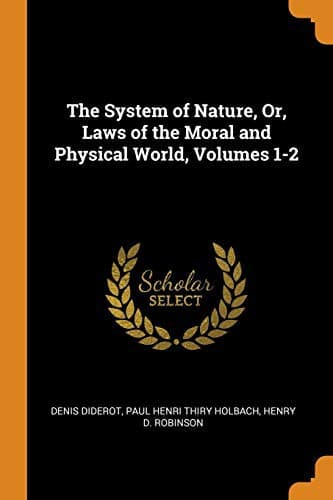
The System of Nature, or, the Laws of the Moral and Physical World. Volume 1Holbach, Paul Henri Thiry, baron d'
Religion
The System of Nature, or, the Laws of the Moral and Physical World. Volume 1
Holbach, Paul Henri Thiry, baron d'
Materialism; Philosophy and religion; Psychology
Reason by no means forbids man from forming capacious desires; ambition
is a passion useful to his species when it has for, its object the
happiness of his race. Great minds, elevated souls, are desirous of
acting on an extended sphere; geniuses who are powerful, beings who are
enlightened, men who are beneficent, distribute very widely their benign
influence; they must necessarily, in order to promote their own peculiar
felicity, render great numbers happy. So many princes fail to enjoy true
happiness only, because their feeble, narrow souls, are obliged to act
in a sphere too extensive for their energies: it is thus that by the
supineness, the indolence, the incapacity of their chiefs, nations
frequently pine in misery; are often submitted to masters, whose
exility of mind is as little calculated to promote their own immediate
happiness, as it is to further that of their miserable subjects. On
the other hand, souls too vehement, too much inflamed, too active, are
themselves tormented by the narrow sphere that confines them; their
ardour misplaced, becomes the scourge of the human race. Alexander was
a monarch who was equally injurious to the earth, equally discontented
with his condition, as the indolent despot whom he dethroned. The souls
of neither were by any means commensurate with their sphere of action.
The happiness of man will never be more than the result of the harmony
that subsists between his desires and his circumstances. The sovereign
power to him who knows not how to apply it to the advantage of his
citizens, is as nothing; it cannot even conduce to his own peculiar
happiness. If it renders him miserable, it is a real evil; if it
produces the misfortune of a portion of the human race, it is a
detestable abuse. The most powerful princes are ordinarily such
strangers to happiness, their subjects are commonly so unfortunate, only
because the first possess all the means of rendering themselves happy
without ever giving them activity; or because the only knowledge they
have of them, is their abuse. A wise man seated on a throne, would be
the most happy of mortals. A monarch is a man for whom his power, let
it be of whatever extent, cannot procure other organs, other modes of
feeling, than the meanest of his subjects; if he has an advantage
over them, it is by the grandeur, the variety, the multiplicity of the
objects with which he can occupy himself; which by giving perpetual
activity to his mind, can prevent it from decay; from falling into
sloth. If his soul is virtuous, if his mind is expansive, his ambition
finds continual food in the contemplation of the power he possesses,
to unite by gentleness, to consolidate by kindness, the will of his
subjects with his own; to interest them in his own conservation, to
merit their affections,--to draw forth the respect of strangers,--to
render luminous the page of history--to elicit the eulogies of all
nations--to clothe the orphan,--to dry the widow's tears. Such are
Public-domain text, read in full here on John Shaqi.
Reviews
Reviews
No reviews yet
Be the first to share your thoughts on this work.
Elsewhere in the archive
Join the Discussion
Join the discussion
Sign in to leave a comment or review.
Sign InorCreate an account