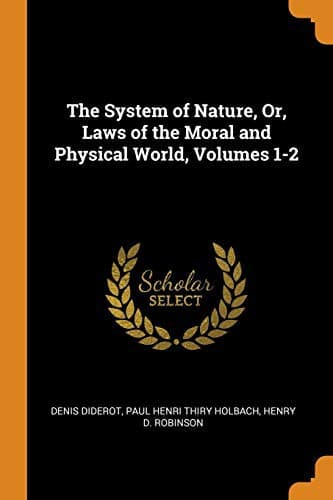
The System of Nature, or, the Laws of the Moral and Physical World. Volume 1Holbach, Paul Henri Thiry, baron d'
Religion
The System of Nature, or, the Laws of the Moral and Physical World. Volume 1
Holbach, Paul Henri Thiry, baron d'
Materialism; Philosophy and religion; Psychology
The human body is said to be in order, when its various component parts
act in that mode, from which results the conservation of the whole; from
which emanates that which is the tendency of his actual existence;
in other words, when all the impulse he receives, all the motion he
communicates, tends to preserve his health, to render him happy, by
promoting the happiness of his fellow men. He is said to be in health
when the fluids and solids of his body concur to render him robust, to
keep his mind in vigour; when each lends mutual aid towards this end. He
is said to be in _confusion_, or in ill health, whenever this tendency
is disturbed; when any of the essential parts of his body cease to
concur to his preservation, or to fulfil its peculiar functions. This
it is that happens in a state of sickness, in which, however, the motion
excited in the human machine is as necessary, is regulated by laws as
certain, as natural, as invariable, as that which concurs to produce
health. Sickness merely produces in him a new order of motion, a new
series of action, a new chain of things. Man dies: to him, this appears
the greatest confusion he can experience; his body is no longer what it
was--its parts no longer concur to the same end--his blood has lost
its circulation--he is deprived of feeling--his ideas have vanished--he
thinks no more--his desires have fled--death is the epoch, the cessation
of his human existence.--His frame becomes an inanimate mass, by the
subtraction of those principles by which it was animated; that is, which
made it act after a determinate manner: its tendency has received a
new direction; its action is changed; the motion excited in its ruins
conspires to a new end. To that motion, the harmony of which he calls
order, which produced life, sentiment, thought, passions, health,
succeeds a series of motion of another species; that, nevertheless,
follows laws as necessary as the first; all the parts of the dead
man conspire to produce what is called dissolution, fermentation,
putrefaction: these new modes of being, of acting, are just as natural
to man, reduced to this state, as sensibility, thought, the periodical
motion of the blood, &c. were to the living man: his essence having
changed, his mode of action can no longer be the same. To that regulated
motion, to that necessary action, which conspired to the production
of life, succeeds that determinate motion, that series of action which
concurs to produce the dissolution of the dead carcass; the dispersion
of its parts; the formation of new combinations, from which result new
beings; and which, as we have before seen, is the immutable order of
active Nature.
Public-domain text, read in full here on John Shaqi.
Reviews
Reviews
No reviews yet
Be the first to share your thoughts on this work.
Join the Discussion
Join the discussion
Sign in to leave a comment or review.
Sign InorCreate an account