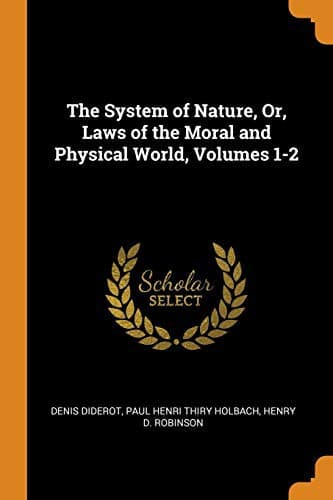
The System of Nature, or, the Laws of the Moral and Physical World. Volume 1Holbach, Paul Henri Thiry, baron d'
Religion
The System of Nature, or, the Laws of the Moral and Physical World. Volume 1
Holbach, Paul Henri Thiry, baron d'
Materialism; Philosophy and religion; Psychology
How then can it be too often repeated, that relatively to the great
whole, all the motion of beings, all their modes of action, can never be
but in order, that is to say, are always conformable to Nature; that in
all the stages through which beings are obliged to pass, they invariably
act after a mode necessarily subordinate to the universal whole? To say
more, each individual being always acts in order; all its actions,
the whole system of its motion, are the necessary consequence of its
peculiar mode of existence; whether that be momentary or durable. Order,
in political society, is the effect of a necessary series of ideas,
of wills, of actions, in those who compose it; whose movements are
regulated in a manner, either calculated to maintain its indivisibility,
or to hasten its dissolution. Man constituted, or modified, in the
manner we term virtuous, acts necessarily in that mode, from whence
results the welfare of his associates: the man we stile wicked, acts
necessarily in that mode, from whence springs the misery of his fellows:
his Nature, being essentially different, he must necessarily act after
a different mode: his individual order is at variance, but his relative
order is complete: it is equally the essence of the one, to promote
happiness, as it is of the other to induce misery.
Thus, order and confusion in individual beings, is nothing more than
the manner of man's considering the natural and necessary effects, which
they produce relatively to himself. He fears the wicked man; he says
that he will carry confusion into society, because he disturbs its
tendency and places obstacles to its happiness. He avoids a falling
stone, because it will derange in him the order necessary to his
conservation. Nevertheless, order and confusion, are always, as we
have shewn, consequences, equally necessary to either the transient or
durable state of beings. It is in order that fire burns, because it
is of its essence to burn; on the other hand, it is in order, that an
intelligent being should remove himself from whatever can disturb his
mode of existence. A being, whose organization renders him sensible,
must in virtue of his essence, fly from every thing that can injure his
organs, or that can place his existence in danger.
Public-domain text, read in full here on John Shaqi.
Reviews
Reviews
No reviews yet
Be the first to share your thoughts on this work.
Elsewhere in the archive
Join the Discussion
Join the discussion
Sign in to leave a comment or review.
Sign InorCreate an account