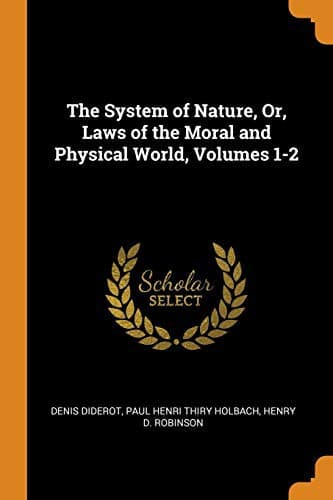
The System of Nature, or, the Laws of the Moral and Physical World. Volume 1Holbach, Paul Henri Thiry, baron d'
Religion
The System of Nature, or, the Laws of the Moral and Physical World. Volume 1
Holbach, Paul Henri Thiry, baron d'
Materialism; Philosophy and religion; Psychology
From what has been said, it must rationally be concluded that _order_ is
never more than the necessary or uniform connection of causes with
their effects; or that series of action which flows from the peculiar
properties of beings, so long as they remain in a given state; that
_confusion_ is nothing more than the change of this state; that in the
universe, all is necessarily in order, because every thing acts and
moves according to the various properties of the different beings it
contains; that in Nature there cannot be either confusion or real evil,
since every thing follows the laws of its natural existence; that there
is neither _chance_ nor any thing fortuitous in this Nature, where no
effect is produced without a sufficient, without a substantial cause;
where all causes act necessarily according to fixed and certain laws,
which are themselves dependant on the essential properties of these
causes or beings, as well as on the combination, which constitutes
either their transitory or permanent state; that intelligence is a mode
of acting, a method of existence natural to some particular beings; that
if this intelligence should be attributed to Nature, it would then be
nothing more than the faculty of conserving herself in active existence
by necessary means. In refusing to Nature the intelligence he himself
enjoys--in rejecting the intelligent cause which is supposed to be the
contriver of this Nature, or the principle of that _order_ he discovers
in her course, nothing is given to _chance_, nothing to a blind cause,
nothing to a power which is indistinguishable; but every thing he
beholds is attributed to real, to known causes; or to those which by
analogy are easy of comprehension. All that exists is acknowledged to
be a consequence of the inherent properties of eternal matter, which by
contact, by blending, by combination, by change of form, produces order
and confusion; with all those varieties which assail his sight, it
is himself who is blind, when he imagines blind causes:--man only
manifested his ignorance of the powers of motion, of the laws of Nature,
when he attributed, any of its effects to _chance_. He did not shew a
more enlightened feeling when he ascribed them to an intelligence, the
idea of which he borrowed from himself, but which is never in conformity
with the effects which he attributes to its intervention--he only
imagined words to supply the place of things--he made JUPITER, SATURN,
JUNO, and a thousand others, operate that which he found himself
inadequate to perform; he distinguished them from Nature, gave them an
amplification of his own properties, and believed he understood them by
thus obscuring ideas, which he never dared either define or analyze.
CHAP. VI.
_Moral and Physical Distinctions of Man.--His Origin._
Public-domain text, read in full here on John Shaqi.
Reviews
Reviews
No reviews yet
Be the first to share your thoughts on this work.
Elsewhere in the archive
Join the Discussion
Join the discussion
Sign in to leave a comment or review.
Sign InorCreate an account