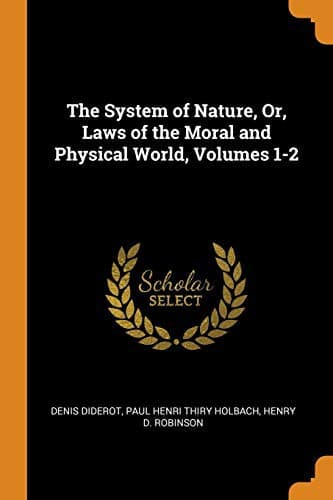
The System of Nature, or, the Laws of the Moral and Physical World. Volume 1Holbach, Paul Henri Thiry, baron d'
Religion
The System of Nature, or, the Laws of the Moral and Physical World. Volume 1
Holbach, Paul Henri Thiry, baron d'
Materialism; Philosophy and religion; Psychology
Let us now apply the general laws we have scrutinized, to those beings
of Nature who interest us the most. Let us see in what man differs from
the other beings by which he is surrounded. Let us examine if he has not
certain points in conformity with them, that oblige him, notwithstanding
the different properties they respectively possess, to act in certain
respects according to the universal laws to which every thing is
submitted. Finally, let us enquire if the ideas he has formed of himself
in meditating on his own peculiar mode of existence, be chimerical, or
founded in reason.
Man occupies a place amidst that crowd, that multitude of beings,
of which Nature is the assemblage. His essence, that is to say, the
peculiar manner of existence, by which he is distinguished from other
beings, renders him susceptible of various modes of action, of a variety
of motion, some of which are simple and visible, others concealed and
complicated. His life itself is nothing more than a long series, a
succession of necessary and connected motion; which operates perpetual
changes in his machine; which has for its principle either causes
contained within himself, such as blood, nerves, fibres, flesh, bones;
in short, the matter, as well solid as fluid, of which his body is
composed--or those exterior causes, which, by acting upon him, modify
him diversely; such as the air with which he is encompassed, the
aliments by which he is nourished, and all those objects from which
he receives any impulse whatever, by the impression they make on his
senses.
Man, like all other beings in Nature, tends to his own destruction--he
experiences inert force--he gravitates upon himself--he is attracted by
objects that are contrary or repugnant to his existence--he seeks after
some--he flies, or endeavours to remove himself from others. It is this
variety of action, this diversity of modification of which the human
being is susceptible, that has been designated under such different
names, by such varied nomenclature. It will be necessary, presently, to
examine these closely and go more into detail.
However marvellous, however hidden, however secret, however complicated
may be the modes of action, which the human frame undergoes, whether
interiorly or exteriorly; whatever may be, or appear to be the impulse
he either receives or communicates, examined closely, it will be found
that all his motion, all his operations, all his changes, all his
various states, all his revolutions, are constantly regulated by the
same laws, which Nature has prescribed to all the beings she brings
forth--which she developes--which she enriches with faculties--of which
she increases the bulk--which she conserves for a season--which she ends
by decomposing, by destroying: obliging them to change their form.
Public-domain text, read in full here on John Shaqi.
Reviews
Reviews
No reviews yet
Be the first to share your thoughts on this work.
Elsewhere in the archive
Join the Discussion
Join the discussion
Sign in to leave a comment or review.
Sign InorCreate an account