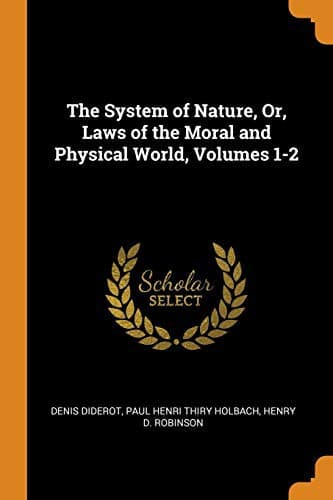
The System of Nature, or, the Laws of the Moral and Physical World. Volume 1Holbach, Paul Henri Thiry, baron d'
Religion
The System of Nature, or, the Laws of the Moral and Physical World. Volume 1
Holbach, Paul Henri Thiry, baron d'
Materialism; Philosophy and religion; Psychology
The beings of the human species, as well as all other beings, are
susceptible of two sorts of motion: the one, that of the mass, by which
an entire body, or some of its parts, are visibly transferred from one
place to another; the other, internal and concealed, of some of which
man is sensible, while some takes place without his knowledge, and is
not even to be guessed at, but by the effect it outwardly produces. In a
machine so extremely complex as man, formed by the combination of such
a multiplicity of matter, so diversified in its properties, so different
in its proportions, so varied in its modes of action, the motion
necessarily becomes of the most complicated kind; its dullness, as well
as its rapidity, frequently escapes the observation of those themselves,
in whom it takes place.
Let us not, then, be surprised, if, when man would account to himself
for his existence, for his manner of acting, finding so many obstacles
to encounter, he invented such strange hypotheses to explain the
concealed spring of his machine--if then this motion appeared to him,
to be different from that of other bodies, he conceived an idea, that he
moved and acted in a manner altogether distinct from the other beings in
Nature. He clearly perceived that his body, as well as different parts
of it, did act; but, frequently, he was unable to discover what
brought them into action: from whence he received the impulse: he then
conjectured he contained within himself a moving principle distinguished
from his machine, which secretly gave an impulse to the springs which
set this machine in motion; that moved him by its own natural energy;
that consequently he acted according to laws totally distinct from those
which regulated the motion of other beings: he was conscious of certain
internal motion, which he could not help feeling; but how could he
conceive, that this invisible motion was so frequently competent to
produce such striking effects? How could he comprehend, that a fugitive
idea, an imperceptible act of thought, was so frequently capacitated
to bring his whole being into trouble and confusion? He fell into the
belief, that he perceived within himself a substance distinguished from
that self, endowed with a secret force; in which he supposed existed
qualities distinctly differing from those, of either the visible
causes that acted on his organs, or those organs themselves. He did not
sufficiently understand, that the primitive cause which makes a stone
fall, or his arm move, are perhaps as difficult of comprehension,
as arduous to be explained, as those internal impulses, of which his
thought or his will are the effects. Thus, for want of meditating
Nature--of considering her under her true point of view--of remarking
the conformity--of noticing the simultaneity, the unity of the motion
of this fancied motive-power with that of his body--of his material
organs--he conjectured he was not only a distinct being, but that he was
Public-domain text, read in full here on John Shaqi.
Reviews
Reviews
No reviews yet
Be the first to share your thoughts on this work.
Elsewhere in the archive
Join the Discussion
Join the discussion
Sign in to leave a comment or review.
Sign InorCreate an account