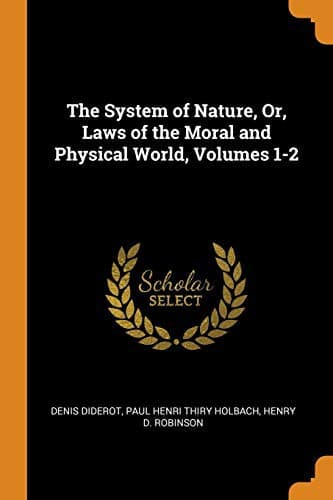
The System of Nature, or, the Laws of the Moral and Physical World. Volume 1Holbach, Paul Henri Thiry, baron d'
Religion
The System of Nature, or, the Laws of the Moral and Physical World. Volume 1
Holbach, Paul Henri Thiry, baron d'
Materialism; Philosophy and religion; Psychology
Let us then conclude, that man has no just, no solid reason to believe
himself a privileged being in Nature; because he is subject to the same
vicissitudes, as all her other productions. His pretended prerogatives
have their foundation in error, arising from mistaken opinions
concerning his existence. Let him but elevate himself by his thoughts
above the globe he inhabits, he will look upon his own species with
the same eyes he does all other beings in Nature: He will then clearly
perceive that in the same manner that each tree produces its fruit, by
reason of its energies, in consequence of its species: so each man acts
by reason of his particular energy; that he produces fruit, actions,
works, equally necessary: he will feel that the illusion which he
anticipates in favour of himself, arises from his being, at one and the
same time, a spectator and a part of the universe. He will acknowledge,
that the idea of excellence which he attaches to his being, has no other
foundation than his own peculiar interest; than the predilection he
has in favour of himself--that the doctrine he has broached with such
seeming confidence, bottoms itself on a very suspicious foundation,
namely IGNORANCE and SELF-LOVE.
CHAP. VII.
_The Soul and the Spiritual System_.
Man, after having gratuitously supposed himself composed of two distinct
independent substances, that have no common properties, relatively with
each other; has pretended, as we have seen, that that which actuated him
interiorly, that motion which is invisible, that impulse which is
placed within himself, is essentially different from those which act
exteriorly. The first he designated, as we have already said, by the
name of a SPIRIT or a SOUL. If however it be asked, what is a spirit?
The moderns will reply, that the whole fruit of their metaphysical
researches is limited to learning that this motive-power, which they
state to be the spring of man's action, is a substance of an unknown
nature; so simple, so indivisible, so deprived of extent, so invisible,
so impossible to be discovered by the senses, that its parts cannot be
separated, even by abstraction or thought. The question then arises, how
can we conceive such a substance, which is only the negation of every
thing of which we have a knowledge? How form to ourselves an idea of a
substance, void of extent, yet acting on our senses; that is to say,
on those organs which are material, which have extent? How can a
being without extent be moveable; how put matter in action? How can a
substance devoid of parts, correspond successively with different parts
of space? But a very cogent question presents itself on this occasion:
if this distinct substance that is said to form one of the component
parts of man, be really what it is reported, and if it be not, it is
not what it is described; if it be unknown, if it be not pervious to
the senses; if it be invisible, by what means did the metaphysicians
Public-domain text, read in full here on John Shaqi.
Reviews
Reviews
No reviews yet
Be the first to share your thoughts on this work.
Elsewhere in the archive
Join the Discussion
Join the discussion
Sign in to leave a comment or review.
Sign InorCreate an account