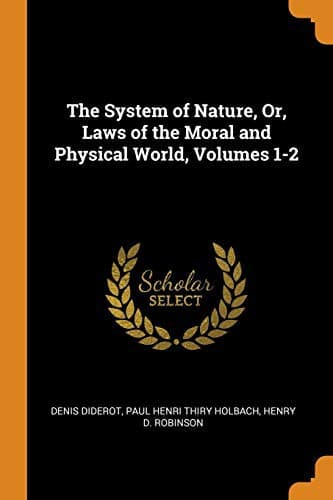
The System of Nature, or, the Laws of the Moral and Physical World. Volume 1Holbach, Paul Henri Thiry, baron d'
Religion
The System of Nature, or, the Laws of the Moral and Physical World. Volume 1
Holbach, Paul Henri Thiry, baron d'
Materialism; Philosophy and religion; Psychology
Thus, it is for want of consulting experience, by not attending to
reason, that man has darkened his ideas upon the concealed principle of
his motion. If, disentangled from prejudice--if, destitute of gratuitous
suppositions--if, throwing aside error, he would contemplate his soul,
or the moving principle that acts within him, he would be convinced that
it forms a part of its body, that it cannot be distinguished from
it, but by abstraction; that it is only the body itself, considered
relatively with some of its functions, or with those faculties of which
its nature, or its peculiar organization, renders it susceptible:--he
will perceive that this soul is obliged to undergo the same changes as
the body; that it is born with it; that it expands itself with it;
that like the body, it passes through a state of infancy, a period of
weakness, a season of inexperience; that it enlarges itself, that it
strengthens itself, in the same progression; that like the body, it
arrives at an adult age or reaches maturity; that it is then, and not
till then, it obtains the faculty of fulfilling certain functions; that
it is in this stage, and in no other, that it enjoys reason; that it
displays more or less wit, judgment, and manly activity; that like the
body, it is subject to those vicissitudes which exterior causes obliges
it to undergo by their influence; that, conjointly with the body, it
suffers, enjoys, partakes of its pleasures, shares its pains, is sound
when the body is healthy, and diseased when the body is oppressed
with sickness; that like the body, it is continually modified by the
different degrees of density in the atmosphere; by the variety of the
seasons, and by the various properties of the aliments received into
the stomach: in short, he would be obliged to acknowledge that at some
periods it manifests visible signs of torpor, stupefaction, decrepitude,
and death.
In despite of this analogy, or rather this continual identity, of
the soul with the body, man has been desirous of distinguishing their
essence; he has therefore made the soul an inconceivable being: but
in order that he might form to himself some idea of it, he was,
notwithstanding, obliged to have recourse to material beings, and to
their manner of acting. The word _spirit_, therefore, presents to the
mind no other ideas than those of breathing, of respiration, of wind.
Thus, when it is said the _soul is a spirit_, it really means nothing
more than that its mode of action is like that of breathing: which
though invisible in itself, or acting without being seen, nevertheless
produces very visible effects. But breath, it is acknowledged, is a
material cause; it is allowed to be air modified; it is not, therefore,
a simple or pure substance, such as the moderns designate under the name
of SPIRIT.
Public-domain text, read in full here on John Shaqi.
Reviews
Reviews
No reviews yet
Be the first to share your thoughts on this work.
Elsewhere in the archive
Join the Discussion
Join the discussion
Sign in to leave a comment or review.
Sign InorCreate an account