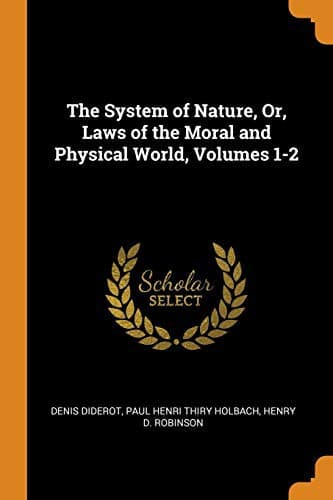
The System of Nature, or, the Laws of the Moral and Physical World. Volume 1Holbach, Paul Henri Thiry, baron d'
Religion
The System of Nature, or, the Laws of the Moral and Physical World. Volume 1
Holbach, Paul Henri Thiry, baron d'
Materialism; Philosophy and religion; Psychology
Those who have distinguished the soul from the body, appear only to
have distinguished their brain from themselves. Indeed, the brain is the
common center, where all the nerves, distributed through every part of
the body, meet and blend themselves: it is by the aid of this interior
organ that all those operations are performed which are attributed to
the soul: it is the impulse, or the motion, communicated to the nerve,
which modifies the brain: in consequence, it re-acts, or gives play to
the bodily organs; or rather it acts upon itself, and becomes capable
of producing within itself a great variety of motion, which has been
designated _intellectual faculties_.
From this it may be seen that some philosophers have been desirous to
make a spiritual substance of the brain. It is evidently nothing but
ignorance that has given birth to and accredited this system, which
embraces so little, either of the natural or the rational. It is from
not having studied himself, that man has supposed he was compounded with
an agent, essentially different from his body: in examining this body,
he will find that it is quite useless to recur to hypothesis for the
explanation of the various phenomena it presents to his contemplation;
that hypothesis can do nothing more than lead him out of the right road
to the information after which he seeks. What obscures this question,
arises from this, that man cannot see himself: indeed, for this purpose,
that would be requisite which is impossible; namely, that he could he
at one and the same moment both within and without himself: he may be
compared to an Eolian harp, that issues sounds of itself, and should
demand what it is that causes it to give them forth? It does not
perceive that the sensitive quality of its chords causes the air to
brace them; that being so braced, it is rendered sonorous by every gust
of wind with which it happens to come in contact.
When a theologian, obstinately bent on admitting into man two substances
essentially different, is asked why he multiplies beings without
necessity? he will reply, because _"thought cannot be a property of
matter."_ If, then, it be enquired of him, _cannot God give to matter
the faculty of thought?_ he will answer, _"no! seeing that God cannot
do impossible things!"_ According to his principles, it is as impossible
that spirit or thought can produce matter, as it is impossible that
matter can produce spirit or thought: it might, therefore, be concluded
against him, that the world was not made by a spirit, any more than a
spirit was made by the world. But in this case, does not the theologian,
according to his own assertion, acknowledge himself to be the true
atheist? Does he not, in fact, circumscribe the attributes of the
Deity, and deny his power, to suit his own purpose? Yet these men demand
implicit belief in doctrines, which they are obliged to maintain by the
most contradictory assertions.
Public-domain text, read in full here on John Shaqi.
Reviews
Reviews
No reviews yet
Be the first to share your thoughts on this work.
Elsewhere in the archive
Join the Discussion
Join the discussion
Sign in to leave a comment or review.
Sign InorCreate an account