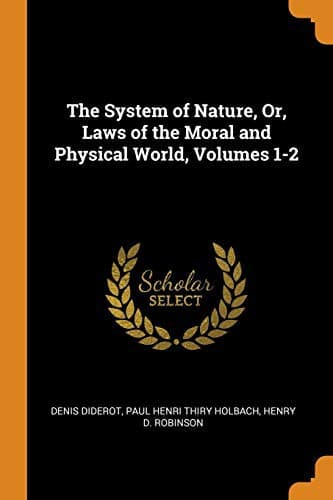
The System of Nature, or, the Laws of the Moral and Physical World. Volume 1Holbach, Paul Henri Thiry, baron d'
Religion
The System of Nature, or, the Laws of the Moral and Physical World. Volume 1
Holbach, Paul Henri Thiry, baron d'
Materialism; Philosophy and religion; Psychology
The first faculty we behold in the living man, and that from which all
his others flow, is _feeling_: however inexplicable this faculty may
appear, on a first view, if it be examined closely, it will be found
to be a consequence of the essence, or a result of the properties
of organized beings; the same as _gravity, magnetism, elasticity,
electricity_, &c. result from the essence or nature of some others. We
shall also find these last phenomena are not less inexplicable than that
of feeling. Nevertheless, if we wish to define to ourselves a clear and
precise idea of it, we shall find that feeling is a particular manner of
being moved--a mode of receiving an impulse peculiar to certain organs
of animated bodies, which is occasioned by the presence of a material
object that acts upon these organs, and transmit the impulse or shock to
the brain.
Man only feels by the aid of nerves dispersed through his body; which is
itself, to speak correctly, nothing more than a great nerve; or may
be said to resemble a large tree, of which the branches experience the
action of the root, communicated through the trunk. In man the nerves
unite and lose themselves in the brain; that intestine is the true seat
of feeling: like the spider in the centre of his web, it is quickly
warned of all the changes that happen to the body, even at the
extremities to which it sends its filaments and branches. Experience
enables us to ascertain, that man ceases to feel in those parts of his
body of which the communication with the brain is intercepted; he feels
very little, or not at all, whenever this organ is itself deranged or
affected in too lively a manner. A proof of this is afforded in the
transactions of the Royal Academy of Sciences at Paris: they inform us
of a man who had his scull taken off, in the room of which his brain was
recovered with skin; in proportion as a pressure was made by the hand on
his brain, the man fell into a kind of insensibility, which deprived
him of all feeling. BARTOLIN says, the brain of a man is twice as big as
that of an ox. This observation had been already made by ARISTOTLE.
In the dead body of an idiot dissected by WILLIS, the brain was found
smaller than ordinary: he says the greatest difference he found between
the parts of the body of this idiot, and those of wiser men, was, that
the plexus of the intercostal nerves, which is the mediator between the
brain and the heart, was extremely small, accompanied by a less number
of nerves than usual. According to WILLIS, the ape is, of all animals,
that which has the largest brain, relatively to his size: he is also,
after man, that which has the most intelligence: this is further
confirmed, by the name he bears in the soil, to which he is indigenous,
which is _ourang outang_, or the man beast. There is, therefore, every
reason to believe that it is entirely in the brain, that consists the
difference, that is found not only between man and beasts, but also
Public-domain text, read in full here on John Shaqi.
Reviews
Reviews
No reviews yet
Be the first to share your thoughts on this work.
Elsewhere in the archive
Join the Discussion
Join the discussion
Sign in to leave a comment or review.
Sign InorCreate an account