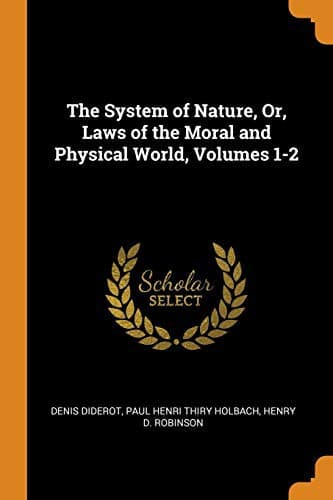
The System of Nature, or, the Laws of the Moral and Physical World. Volume 1Holbach, Paul Henri Thiry, baron d'
Religion
The System of Nature, or, the Laws of the Moral and Physical World. Volume 1
Holbach, Paul Henri Thiry, baron d'
Materialism; Philosophy and religion; Psychology
In short, as there will be an opportunity presently to prove, all
the intellectual faculties--that is to say, all the modes of action
attributed to the soul, may be reduced to the modifications, to the
qualities, to the modes of existence, to the changes produced by the
motion of the brain; which is visibly in man the seat of feeling, the
principle of all his actions. These modifications are to be attributed
to the objects that strike on his senses; of which the impression is
transmitted to the brain, or rather to the ideas, which the perceptions
caused by the action of these objects on his senses have there
generated, and which it has the faculty to re-produce. This brain moves
itself in its turn, re-acts upon itself, gives play to the organs, which
concentrate themselves in it, or which are rather nothing more than an
extension of its own peculiar substance. It is thus the concealed motion
of the interior organ, renders itself sensible by outward and visible
signs. The brain, affected by a modification which is called FEAR,
diffuses a paleness over the countenance, excites a tremulous motion in
the limbs called trembling. The brain, affected by a sensation of GRIEF,
causes tears to flow from the eyes, even without being moved by any
exterior object; an idea which it retraces with great strength, suffices
to give it very little modifications, which visibly have an influence on
the whole frame.
In all this, nothing more is to be perceived than the same substance
which acts diversely on the various parts of the body. If it be objected
that this mechanism does not sufficiently explain the principles of the
motion or the faculties of the soul; we reply, that it is in the same
situation as all the other bodies of Nature, in which the most simple
motion, the most ordinary phenomena, the most common modes of action are
inexplicable mysteries, of which we shall never be able to fathom the
first principles. Indeed, how can we flatter ourselves we shall ever be
enabled to compass the true principle of that gravity by which a stone
falls? Are we acquainted with the mechanism which produces attraction in
some substances, repulsion in others? Are we in a condition to explain
the communication of motion from one body to another? But it may be
fairly asked,--Are the difficulties that occur, when attempting to
explain the manner in which the soul acts, removed by making it a
_spiritual being_, a substance of which we have not, nor cannot form one
idea, which consequently must bewilder all the notions we are capable
of forming to ourselves of this being? Let us then be contented to know
that the soul moves itself, modifies itself, in consequence of material
causes, which act upon it which give it activity: from whence the
conclusion may be said to flow consecutively, that all its operations,
all its faculties, prove that it is itself _material_.
CHAP. IX.
Public-domain text, read in full here on John Shaqi.
Reviews
Reviews
No reviews yet
Be the first to share your thoughts on this work.
Elsewhere in the archive
Join the Discussion
Join the discussion
Sign in to leave a comment or review.
Sign InorCreate an account