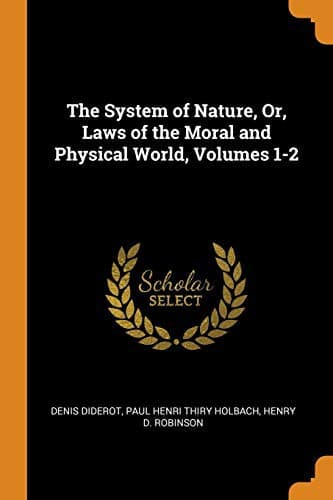
The System of Nature, or, the Laws of the Moral and Physical World. Volume 2Holbach, Paul Henri Thiry, baron d'
Religion
The System of Nature, or, the Laws of the Moral and Physical World. Volume 2
Holbach, Paul Henri Thiry, baron d'
Materialism; Philosophy and religion; Psychology
If incomprehensibility be not a sufficient reason for absolutely denying
the possibility of immateriality, it certainly is not of a cogency
to establish its existence; we shall always be less in a capacity
to comprehend a spiritual cause, than one that is material; because
materiality is a known quality; spirituality is an occult, an unknown
quality; or rather it is a mode of speech of which we avail ourselves
to throw a veil over our own ignorance. We are repeatedly told that our
senses only bring us acquainted with the external of things; that our
limited ideas are not capable of conceiving immaterial beings: we agree
frankly to this position; but then our senses do not even shew us the
external of these immaterial substances, Which the theologians will
nevertheless attempt to define to us; upon which they unceasingly
dispute among themselves; upon which even until this day they are not
in perfect unison with each other. The great John Locke in his familiar
letters, says, "I greatly esteem all those who faithfully defend their
opinions; but there are so few persons who, according to the manner they
do defend them, appear fully convinced of the opinions they profess,
that I am tempted to believe there are more sceptics in the world than
are generally imagined."
Abady, one of the most strenuous supporters of immaterialism, says, "The
question is not what incorporeity is, but whether it be." To settle this
disputable point, it were necessary to have some data whereon to form
our judgment; but how assure ourselves of the existence of that, of
which we shall never be competent to have a knowledge? If we are not
told what this is; if some tangible evidence be not offered to the human
mind; how shall we feel ourselves capacitated to judge whether or not
its existence be even possible? How form an estimate of that picture
whose colours elude our sight, whose design we cannot perceive, whose
features have no means of becoming familiar to our mind, whose very
canvas refuses itself to our all research, of which the artist himself
can afford no other idea, no other description, but that it is, although
he himself can neither shew us how or where! We have seen the ruinous
foundations upon which men have hitherto erected this fanciful idea of
immateriality; we have examined the proofs which they have offered,
if proofs they can be called, in support of their hypothesis; we have
sifted the evidence they have been willing to have accredited, in
order to establish their position; we have pointed out the numberless
contradictions that result from their want of union on this subject,
from the irreconcileable qualities with which they clothe their
imaginary system. What conclusion, then, ought fairly, rationally,
consistently, to be drawn from the whole? Can we, or can we not admit
their argument to be conclusive, such as ought to be received by beings
who think themselves sane? Will it allow any other inference than that
Public-domain text, read in full here on John Shaqi.
Reviews
Reviews
No reviews yet
Be the first to share your thoughts on this work.
Elsewhere in the archive
Join the Discussion
Join the discussion
Sign in to leave a comment or review.
Sign InorCreate an account