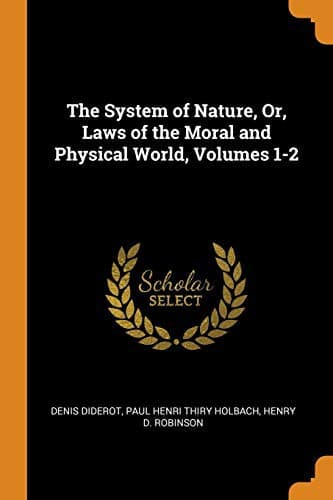
The System of Nature, or, the Laws of the Moral and Physical World. Volume 2Holbach, Paul Henri Thiry, baron d'
Religion
The System of Nature, or, the Laws of the Moral and Physical World. Volume 2
Holbach, Paul Henri Thiry, baron d'
Materialism; Philosophy and religion; Psychology
would be entirely on the word of the theologian himself, that we should
ground our faith; that we should yield our belief. If these things are
to the human species what colours are to the man born blind, they have
at least no existence with relation to ourselves. It will avail the
blind man nothing to tell him these colours have no less existence,
because he cannot see them. But what shall we say of that portrait whose
colours the blind man attempts to explain, whose features he is willing
we should receive upon his authority, whose proportions are to be taken
from his description, merely because we know he cannot behold them?
The Doctor, although unwilling to relinquish his subject, removes none
of the difficulty when he asks, "Are our five senses, by an absolute
necessity in the nature of the thing, all and the only possible ways of
perception? And is it impossible and contradictory there should be any
being in the universe, indued with ways of perception different from
these that are the result of our present composition? Or are these
things, on the contrary, purely arbitrary; and the same power that gave
us these, may have given others to other beings, and might, if he
had pleased have given to us others in this present state?" It seems
perfectly unnecessary to the true point of the argument to reason upon
what can or cannot be done: I therefore reply, that the fact is, we have
but five senses: by the aid of these man is not competent to form any
idea whatever of immateriality; but he is also in as absolute a state of
ignorance, upon what might be his capabilities of conception, if he had
more senses. It is rather acknowledging a weakness in his evidence,
on the part of the Doctor, to be thus obliged to rest it upon the
supposition of what might be the case, if man was a being different to
what he is; in other words, that they would be convincing to mankind
if the human race were not human beings. Therefore to demand what the
Divinity could have done in such a case, is to suppose the thing
in question, seeing we cannot form an idea how far the power of
the Divinity extends: but we may be reasonably allowed to use the
theological argument in elucidation; these men very gravely insist,
upon what authority must be best known to themselves, "that God cannot
communicate to his works that perfection which he himself possesses;"
at the same moment they do not fail to announce his omnipotence. Will
it require any capacity, more than is the common lot of a child, to
comprehend the absurd contradiction of the two assertions? As beings
possessing but five senses, we must then, of necessity, regulate our
judgment by the information they are capable of affording us: we cannot,
by any possibility, have a knowledge of those, which confer the capacity
to comprehend beings, of an order entirely distinguished from that
in which we occupy a place. We are ignorant of the mode in which even
plants vegetate, how then be acquainted with that which has no affinity
Public-domain text, read in full here on John Shaqi.
Reviews
Reviews
No reviews yet
Be the first to share your thoughts on this work.
Elsewhere in the archive
Join the Discussion
Join the discussion
Sign in to leave a comment or review.
Sign InorCreate an account