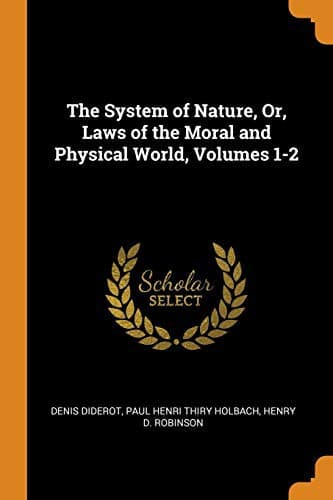
The System of Nature, or, the Laws of the Moral and Physical World. Volume 2Holbach, Paul Henri Thiry, baron d'
Religion
The System of Nature, or, the Laws of the Moral and Physical World. Volume 2
Holbach, Paul Henri Thiry, baron d'
Materialism; Philosophy and religion; Psychology
If we have an idea of the attributes of God, it is only because we
clothe him with those which belong to ourselves; which we never do more
than aggrandize, which we only augment or exaggerate; we then mistake
them for those qualities with which we were at first acquainted. If in
all those substances which are pervious to our senses, we only know them
by the effects they produce on us, after which we assign them qualities,
at least these qualities are something tangible, they give birth to
clear and distinct ideas. This superficial knowledge, however slender
it may be, with which our senses furnish us, is the only one we can
possibly have; constituted as we are, we find ourselves under the
necessity of resting contented with it, and we discover that it is
sufficient for our wants; but we have not even the most superficial idea
of immateriality, or a substance distinguished from all those with which
we have the slightest acquaintance. Nevertheless, we hear men hourly
reasoning upon it, disputing about its properties, advancing its
faculties, as if they had the most demonstrable evidence of the fact;
tearing each other in pieces, because the one does not readily admit
what the other asserts, upon a subject which no man is competent to
understand.
Our author goes on "We only have a knowledge of God by his attributes,
by his properties, by the excellent and wise arrangement which he
has given to all things, and by their FINAL CAUSES: we admire him
in consequence of his perfections." I repeat, that we have no real
knowledge of the Divinity; that we borrow his attributes from ourselves;
but it is evident these cannot be suitable to the Universal Being, who
neither can have the same nature nor the same properties as particular
beings; it is nevertheless after ourselves that we assign him
intelligence, wisdom, perfection, in subtracting from them what we call
defects. As to the order, or the arrangement of the universe, man finds
it excellent, esteems it the perfection of wisdom, as long as it is
favorable to his species; or when the causes which are co-existent with
himself do not disturb his own peculiar existence; otherwise he is apt
to complain of confusion, and final causes vanish: he then attributes to
an immutable God, motives equally borrowed from his own peculiar mode
of action, for deranging the beautiful order he so much admires in the
universe. Thus it is always in himself, that is, in his own individual
mode of feeling, that he draws up the ideas of the order, the wisdom,
the excellence, the perfection which he ascribes to the Deity; whilst
the good as well as the evil which take place in the world, are
the necessary consequence of the essence of things; of the general,
immutable laws of nature; in short, of the gravitation, of the repulsion
of matter; of those unchangeable laws of motion, which Newton himself
has so ably thrown into light; but which he has by a strange fatuity
Public-domain text, read in full here on John Shaqi.
Reviews
Reviews
No reviews yet
Be the first to share your thoughts on this work.
Elsewhere in the archive
Join the Discussion
Join the discussion
Sign in to leave a comment or review.
Sign InorCreate an account