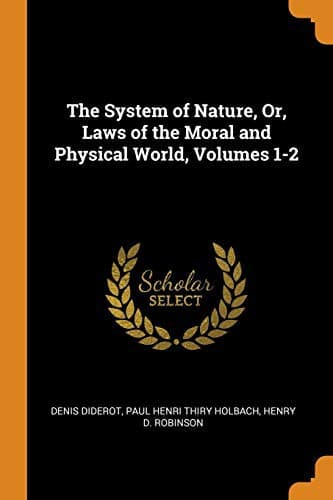
The System of Nature, or, the Laws of the Moral and Physical World. Volume 2Holbach, Paul Henri Thiry, baron d'
Religion
The System of Nature, or, the Laws of the Moral and Physical World. Volume 2
Holbach, Paul Henri Thiry, baron d'
Materialism; Philosophy and religion; Psychology
Deity against mankind, are now well understood to be common effects of
natural causes.
Order, as we have elsewhere shewn, is only the effects which result
to ourselves from a series of motion; there cannot be any disorder
relatively to the great whole; in which all that takes place is
necessary; in which every thing is determined by laws which nothing can
change. The order of nature may be damaged or destroyed relatively to
ourselves, but it is never contradicted relatively to herself, since she
cannot act otherwise than she does: if we attribute to her the evils we
sustain, we are equally obliged to acknowledge we owe to her the good we
experience.
It in said, that animals furnish a convincing proof of the powerful
cause of their existence; that the admirable harmony of their parts, the
mutual assistance they lend each other, the regularity with which
they fulfill their functions, the preservation of these parts, the
conservation of such complicated wholes, announce a workman who unites
wisdom with power; in short, whole tracts of anatomy and botany have
been copied to prove nothing more than that these things exist, for of
the power that produced them there cannot remain a doubt. We shall never
learn more from these erudite tracts, save that there exists in nature
certain elements with an aptitude to attraction; a disposition to unite,
suitable to form wholes, to induce combinations capable of producing
very striking effects. To be surprised that the brain, the heart, the
arteries, the veins, the eyes, the ears of an animal, act as we see
them--that the roots of plants attract juices, or that trees produce
fruit, is to be surprised that a tree, a plant, or an animal exists at
all. These beings would not exist, or would no longer be that which we
know they are, if they ceased to act as they do: this is what happens
when they die. If the formation, the combination, the modes of action,
variously possessed by these beings, if their conservation for a season,
followed by their destruction or dissolution, prove any thing, it is the
immutability of those laws which operate in nature: we cannot doubt
the power of nature; she produces all the animals we behold, by the
combination, of matter, continually in motion; the harmony that subsists
between the component parts of these beings, is a consequence of the
necessary laws of their nature, and of that which results from their
combination. As soon as this accord ceases, the animal is necessarily
destroyed: from this we must conclude that every mutation in nature
is necessary; is only a consequence of its laws; that it could not be
otherwise than it is, under the circumstances in which it is placed.
Public-domain text, read in full here on John Shaqi.
Reviews
Reviews
No reviews yet
Be the first to share your thoughts on this work.
Elsewhere in the archive
Join the Discussion
Join the discussion
Sign in to leave a comment or review.
Sign InorCreate an account