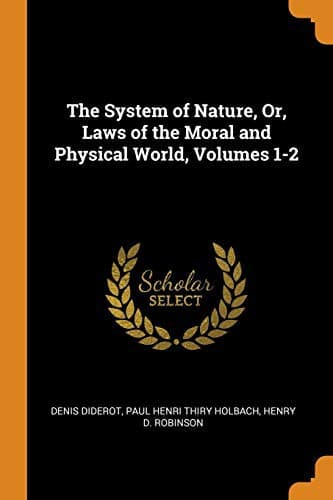
The System of Nature, or, the Laws of the Moral and Physical World. Volume 2Holbach, Paul Henri Thiry, baron d'
Religion
The System of Nature, or, the Laws of the Moral and Physical World. Volume 2
Holbach, Paul Henri Thiry, baron d'
Materialism; Philosophy and religion; Psychology
Whatever efforts the philosopher makes to penetrate the secrets of
nature, he never finds more, as we have many times repeated, than
matter; various in itself, diversely modified in consequence of the
motion it undergoes. Its whole, as well as its parts, displays only
necessary causes producing necessary effects, which flow necessarily
one out of the other: of which the mind, aided by experience, is more
or less competent to discover the concatenation. In virtue of their
specific properties, all the beings that come under our review,
gravitate towards a centre--attract analogous matter--repel that which
is unsuitable to combination--mutually receive and give impulse--acquire
qualities--undergo modifications which maintain them in existence for a
season--are born and dissolved by the operation of an inexorable
decree, that obliges every thing, we behold to pass into a new mode of
existence. It is to these continued vicissitudes that are to be
ascribed all the phenomena, whether trivial or of magnitude; ordinary
or extraordinary; known or unknown; simple or complicated; which are
operated in the universe. It is by these mutations alone that we have
any knowledge of nature: she is only mysterious to those who contemplate
her through the veil of prejudice: her course is always simple to those
who look at her without prepossession.
To attribute the effects to which we are witnesses, to nature, to
matter, variously combined with the motion that is inherent to it, is
to give them an intelligible and known cause; to attempt to penetrate
deeper, is to plunge ourselves into imaginary regions, where we find
only a chaos of obscurities--where we are lost in an unfathomable abyss
of incertitude. Let us then be content with contemplating nature, who,
being self-existent, must in her essence possess motion; which cannot
be conceived without properties, from which result perpetual action
and re-action; or those continual efforts which give birth to such a
numerous train of circumstances; in which a single molecule cannot be
found, that does not necessarily occupy the place assigned to it, by
immutable and necessary laws--that is for an instant in an absolute
state of repose. What necessity can there exist to seek out of matter
for a power to give it play, since its motion flows as necessarily out
of its existence as its bulk, its form, its gravity, &c. since nature in
inaction would no longer be nature?
Public-domain text, read in full here on John Shaqi.
Reviews
Reviews
No reviews yet
Be the first to share your thoughts on this work.
Elsewhere in the archive
Join the Discussion
Join the discussion
Sign in to leave a comment or review.
Sign InorCreate an account