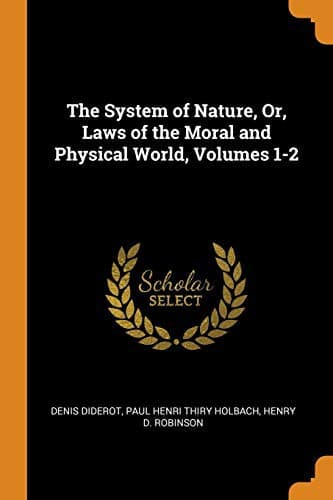
The System of Nature, or, the Laws of the Moral and Physical World. Volume 2Holbach, Paul Henri Thiry, baron d'
Religion
The System of Nature, or, the Laws of the Moral and Physical World. Volume 2
Holbach, Paul Henri Thiry, baron d'
Materialism; Philosophy and religion; Psychology
In despite of all their subtilties, the theologians cannot do otherwise;
like all the beings of the human species, they have a knowledge of
matter alone: they have no real idea of a pure spirit. When they speak
of the intelligence, of the wisdom, of the designs of their gods, they
are always those of men which they describe, that they obstinately
persist in giving to beings, of which, according to their own shewing,
to the evidence they themselves adduce, their essence does not render
them susceptible; who if they had those qualities with which they clothe
them, would from that very moment cease to be incorporeal; would be in
the truest sense of the word, substantive matter. How shall we reconcile
the assertion, that beings who have not occasion for any thing--who are
sufficient to them selves--whose projects must be executed as soon as
they are formed; can have volition, passions, desires? How shall we
attribute anger to beings without either blood or bile? How can we
conceive an omnipotent being (whose wisdom we admire in the striking
order he has himself established in the universe,) can permit that this
beautiful arrangement should be continually disturbed, either by the
elements in discord, or by the crimes of human beings? In short, this
being cannot have any one of the human qualities, which always depend
upon the peculiar organization of man--upon his wants--upon his
institutions, which are themselves always relative to the society
in which he lives. The theologian vainly strives to aggrandize, to
exaggerate in idea, to carry to perfection by dint of abstraction, the
moral qualities of man; they are unsuitable to the Divinity; in vain it
is asserted they are in him of a different nature from what they are
in his creatures; that they are perfect; infinite; supreme; eminent; in
holding this language, they no longer understand themselves; they can
have no one idea of the qualities they are describing, seeing that
man can never have a conception of them, but inasmuch as they bear an
analogy to the same qualities in himself.
Public-domain text, read in full here on John Shaqi.
Reviews
Reviews
No reviews yet
Be the first to share your thoughts on this work.
Elsewhere in the archive
Join the Discussion
Join the discussion
Sign in to leave a comment or review.
Sign InorCreate an account