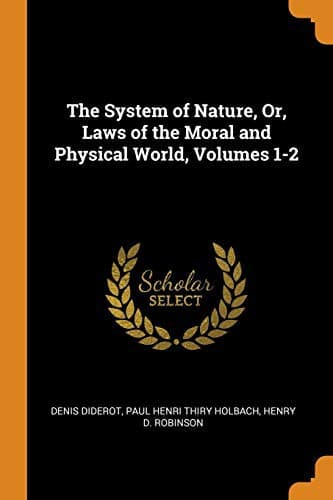
The System of Nature, or, the Laws of the Moral and Physical World. Volume 2Holbach, Paul Henri Thiry, baron d'
Religion
The System of Nature, or, the Laws of the Moral and Physical World. Volume 2
Holbach, Paul Henri Thiry, baron d'
Materialism; Philosophy and religion; Psychology
These never-ending disputes, these perpetual variations, ought, at
least, to convince the unprejudiced, that the ideas of the Divinity have
neither the generally-admitted evidence, nor the certitude which are
attributed to them; on the contrary, these contrarieties in the opinions
of the theologians, if submitted to the logic of the schools, might be
fatal to the whole of them: according to that mode of reasoning, which
at least has the sanction of our universities, all the probabilities in
the world cannot acquire the force of a demonstration; a truth is
not made evident but when constant experience, reiterated reflection,
exhibits it always under the same point of view; the evidence of a
proposition cannot be admitted unless it carries with it a substantive
demonstration; from the constant relation which is made by well
constituted senses, results that evidence, that certitude, which alone
can produce full conviction: if the major proposition of a syllogism
should be overturned by the minor, the whole falls to the ground.
Cicero, who is no mean authority on such a subject, says expressly, "No
reasoning can render that false, which experience has demonstrated as
evident." Wolff, in his Ontology, says; "That which is repugnant in
itself, cannot possibly be understood; that those things which are in
themselves contradictions, must always be deficient of evidence." St.
Thomas says, "Being, is all that which is not repugnant to existence."
However it may be with these qualities, which the theologians assign to
their immaterial beings, whether they may be irreconcileable, or whether
they are totally incomprehensible, what can result to the human species
in supposing them to have intelligence and views? Can an universal
intelligence, whose care must be equally extended to every thing that
exists, have more direct, more intimate relations with man, who only
forms an insensible portion of the great whole? Can we seriously believe
that it is to make joyful the insects, to gratify the ants of his
garden, that the Monarch of the universe has constructed and embellished
his habitation? Would our feeble eyes, therefore, become stronger--would
our narrow views of things be enlarged--should we be better capacitated
to understand his projects--could we with more certitude divine
his plans, enter into his designs--would our exility of judgment be
competent to measure his wisdom, to follow the eternal order he has
established? Will those effects, which flow from his omnipotence,
emanate from his providence--whether we estimate them as good, or
whether we tax them as evil--whether we consider them beneficial, or
view them as prejudicial--be less the necessary results of his wisdom,
of his justice, of his eternal decrees? In this case can we reasonably
suppose that a Being, so wise, so just, so intelligent, will derange
his system, change his plan, for such weak beings as ourselves? Can we
rationally believe we have the capacity to address worthy prayers, to
Public-domain text, read in full here on John Shaqi.
Reviews
Reviews
No reviews yet
Be the first to share your thoughts on this work.
Elsewhere in the archive
Join the Discussion
Join the discussion
Sign in to leave a comment or review.
Sign InorCreate an account