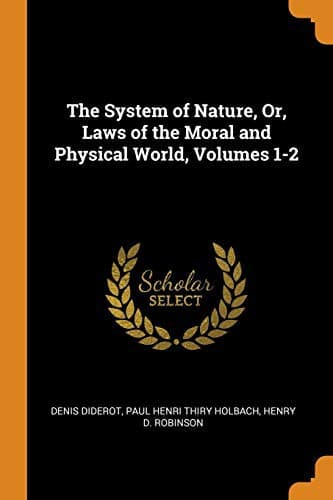
The System of Nature, or, the Laws of the Moral and Physical World. Volume 2Holbach, Paul Henri Thiry, baron d'
Religion
The System of Nature, or, the Laws of the Moral and Physical World. Volume 2
Holbach, Paul Henri Thiry, baron d'
Materialism; Philosophy and religion; Psychology
We see, then, that superstition is founded upon manifest contradictions,
which man must always fall into when he mistakes the natural causes of
things--when he shall attribute the good or evil which he experiences to
an intelligent cause, distinguished from nature, of which he will never
be competent to form to himself any certain ideas. Indeed, man will
always be reduced, as we have so frequently repeated, to the necessity
of clothing his gods with his own imbecile qualities: as he is himself
a changeable being, whose intelligence is limited; who, placed in divers
circumstances, appears to be frequently in contradiction with himself;
although he thinks he honours his gods in giving them his own peculiar
qualities, he in fact does nothing more than lend them his own
inconstancy, cover them with his own weakness, invest them with his own
vices. It is thus that in reasoning, he is unable to account for the
necessity of things--that he imagines there is a confusion which his
prayers will have a tendency to remove--that he thinks the evils of
life more than commensurate with the good: he does not perceive that an
undeviating system, by operating upon beings diversely organized, whose
circumstances are different, whose modes of action are at variance, must
of necessity sometimes appear to be inimical to the interests of
the individual, while it embraces the general good of the whole. The
theologian may subtilize, exaggerate, render as unintelligible as he
pleases, the attributes with which he clothes his divinities, he
will never be able to remove the contradictions which arise from the
discordant qualities which he thus heaps together; neither will he be
able to give man any other mode of judging than what arises from the
exercise of his senses, such as they are actually found. He will never
be able to furnish the idea of an immutable being, while he shall
represent this being as capable of being irritated and appeased by the
prayers of mortals. He will never delineate the features of omnipotence
under the portrait of a being who cannot restrain the actions of his
inferiors. He will never hold up a standard of justice, while he shall
mingle it with mercy, however amiable the quality; or while he shall
represent it as punishing those actions, which the perpetrators were
under the necessity of committing. Neither will he be able, under any
circumstances, to make a finite mind comprehend infinity; much less when
he shall represent this infinity as bounded by finity itself.
Public-domain text, read in full here on John Shaqi.
Reviews
Reviews
No reviews yet
Be the first to share your thoughts on this work.
Elsewhere in the archive
Join the Discussion
Join the discussion
Sign in to leave a comment or review.
Sign InorCreate an account