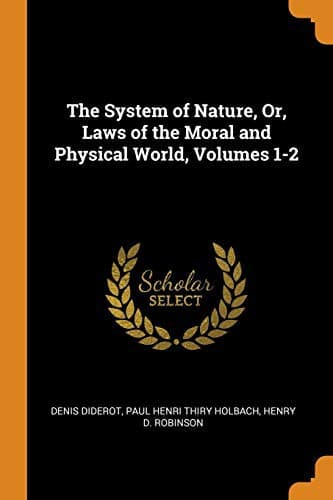
The System of Nature, or, the Laws of the Moral and Physical World. Volume 2Holbach, Paul Henri Thiry, baron d'
Religion
The System of Nature, or, the Laws of the Moral and Physical World. Volume 2
Holbach, Paul Henri Thiry, baron d'
Materialism; Philosophy and religion; Psychology
Those ideas, which have no archetype but in the imagination of man,
must necessarily take their complexion from his own character; must be
clothed with his own passions; must constantly follow the revolutions of
his machine; be lively or gloomy; favourable or prejudicial; friendly
or inimical; sociable or savage; humane or cruel; according as he whose
brain they inhabit shall himself be disposed; in fact, they can never be
more than the shadow of the substance he himself interposes between the
light and the ground on which they are thrown. A mortal plunged from a
state of happiness into misery, whose health merges into sickness, whose
joy is changed into affliction, cannot in these vicissitudes preserve
the same ideas; these naturally depend every instant upon the
variations, which physical sensations oblige his organs to undergo.
It will not therefore appear strange that these opinions should be
fluctuating, when they depend upon the state of the nervous fluid, upon
the greater or less portion of igneous matter floating in the sanguinary
vessels.
_Theism_, or what is called _Natural Religion_, cannot have certain
principles; those who profess it must necessarily be subject to vary in
their opinions--to fluctuate in their conduct, which flows out of
them. A system founded upon wisdom and intelligence, which can never
contradict itself, when circumstances change will presently be converted
into fanaticism; rapidly degenerate into superstition; such a system,
successively meditated by enthusiasts of very distinct characters,
must of necessity experience vicissitudes, and quickly depart from its
primitive simplicity. The greater part of those philosophers who have
been disposed to substitute theism for superstition, have not felt
that it was formed to corrupt itself--to degenerate. Striking examples,
however, prove this fatal truth. Theism is almost every where corrupted;
it has by degrees given way to those superstitions, to those extravagant
sects, to those prejudicial opinions with which the human species is
degraded. As soon as man consents to acknowledge invisible powers out
of nature, upon which his restless mind will never be able invariably to
fix his ideas--which his imagination alone will be capable of painting
to him; whenever he shall not dare to consult his reason relatively to
those powers, it must necessarily be, that the first false step leads
him astray, that his conduct as well as his opinions becomes in the long
run perfectly absurd.
Public-domain text, read in full here on John Shaqi.
Reviews
Reviews
No reviews yet
Be the first to share your thoughts on this work.
Elsewhere in the archive
Join the Discussion
Join the discussion
Sign in to leave a comment or review.
Sign InorCreate an account