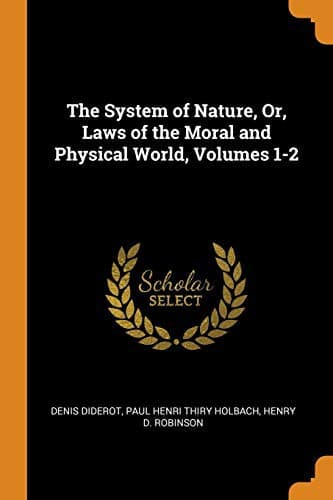
The System of Nature, or, the Laws of the Moral and Physical World. Volume 2Holbach, Paul Henri Thiry, baron d'
Religion
The System of Nature, or, the Laws of the Moral and Physical World. Volume 2
Holbach, Paul Henri Thiry, baron d'
Materialism; Philosophy and religion; Psychology
propensities of those obdurate wretches, who, insensible to the charms
of virtue, are deaf to the advantages that spring from its practice,
than can be opposed by the denunciations, held forth in an hereafter
existence, which he is at the same moment taught may be avoided by
repentance, that shall only take place when the ability to commit
further wrong has ceased. In short, one would be led to think it obvious
to the slightest reflection, that politics, founded upon the nature of
man, upon the principles of society, armed with equitable laws, vigilant
over morals, faithful in rewarding virtue, constant in visiting crime,
would be more suitable to clothe ethics with respectability, to throw a
sacred mantle over moral goodness, to lend stability to public virtue,
than any authority that can be derived from contested systems, the
conduct of whose professors frequently disgrace the doctrines they lay
down, which after all seldom do more than restrain those whose mildness
of temperament effectually prevents them from running into excess; those
who, already given to justice, require no coercion. On the other hand,
we have endeavoured to prove that nothing can be more absurd, nothing
actually more dangerous, than attributing human qualities to the
Divinity which cannot but choose to find themselves in a perpetual
contradiction.
Plato has said "that virtue consists in resembling God." But how is man
to resemble a being, who, it is acknowledged, is incomprehensible to
mankind--who cannot be conceived by any of those means, by which he is
alone capable of having perceptions? If this being, who is shewn to man
under such various aspects, who is said to owe nothing to his creatures,
is the author of all the good, as well as all the evil that takes
place, how can he be the model for the conduct of the human race
living together in society? At most he can only follow one side of the
character, because among his fellows, he alone is reputed virtuous who
does not deviate in his conduct from justice; who abstains from evil;
who performs with punctuality those duties he owes to his fellows. If it
be taken up, and insisted he is not the author of the evil, only of
the good, I say very well: that is precisely what I wanted to know;
you thereby acknowledge he is not the author of every thing; we are no
longer at issue; you are inconclusive to your own premises, consequently
ought not to demand an implicit reliance on what you choose to assert.
Public-domain text, read in full here on John Shaqi.
Reviews
Reviews
No reviews yet
Be the first to share your thoughts on this work.
Elsewhere in the archive
Join the Discussion
Join the discussion
Sign in to leave a comment or review.
Sign InorCreate an account