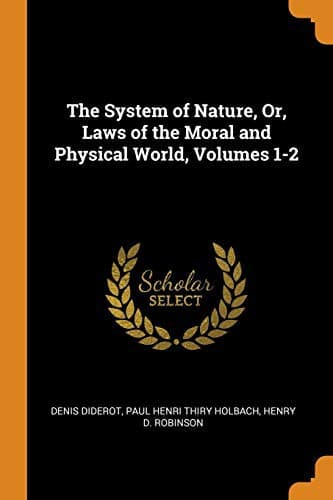
The System of Nature, or, the Laws of the Moral and Physical World. Volume 2Holbach, Paul Henri Thiry, baron d'
Religion
The System of Nature, or, the Laws of the Moral and Physical World. Volume 2
Holbach, Paul Henri Thiry, baron d'
Materialism; Philosophy and religion; Psychology
For thousands of years, nations as well as sovereigns were emulously
despoiling themselves to enrich the expounders of superstition; to
enable them to wallow in abundance: they loaded them with honors,
decorated them with titles, invested them with privileges, granted them
immunities, for no other purpose than to make them bad citizens, unruly
subjects, mischievous beings, who revenged upon society the advantages
they had received. What was the fruit that kings and people gathered
from their imprudent kindness? What was the harvest these men yielded
to their labour? Did princes really become more powerful; were nations
rendered more happy; did they grow more flourishing; did men become more
rational? No! Unquestionably, the sovereign lost the greater portion
of his authority; he was the slave of his priest; and when he wished to
preserve the remnant that was left, or to recover some part of what
had been wrested from him, he was obliged to be continually wrestling
against the men his own indulgence, his own weakness, had furnished
with means, to set his authority at defiance: the riches of society were
lavished to support the idleness, maintain the splendour, satiate the
luxury of the most useless, the most arrogant, the most dangerous of its
members.
Did the morals of the people improve under the pastoral care of these
guides, who were so liberally rewarded? Alas! the superstitious never
knew them, their fanatic creed had usurped the place of every virtue;
its ministers, satisfied with upholding the doctrines, with preserving
the ceremonies so useful to their own interests, only invented
fictitious crimes--multiplied painful penances--instituted absurd
customs; to the end, that they might turn even the transgressions of
their slaves to their own immediate profit. Every where they exercised
a monopoly of expiatory indulgences; they made a lucrative traffic of
pretended pardons from above; they established a tariff, according to
which crime was no longer contraband, but freely admitted upon paying
the customs. Those subjected to the heaviest impost, were always such as
the hierarchy judged most inimical to its own stability; you might at a
very easy rate obtain permission to attack the dignity of the sovereign,
to undermine the temporal power, but it was enormously dear to be
allowed to touch even the hem of the sacerdotal garments. Thus heresy,
sacrilege, &c. were considered crimes of a much deeper dye, that fixed
an indelible stain on the perpetrator, alarmed the mind of the priestly
order, much more seriously than the most inveterate villainy, the
most determined delinquency, which more immediately involved the true
interests of society. Thence the ideas of the people were completely
overturned, imaginary crimes terrified them, while real crimes had
no effect upon their obdurate hearts. A man, whose opinions were at
variance with the received doctrines, whose abstract systems did not
Public-domain text, read in full here on John Shaqi.
Reviews
Reviews
No reviews yet
Be the first to share your thoughts on this work.
Elsewhere in the archive
Join the Discussion
Join the discussion
Sign in to leave a comment or review.
Sign InorCreate an account