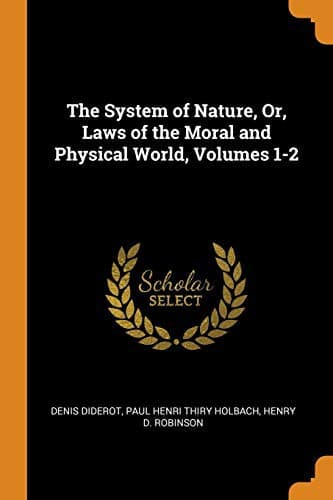
The System of Nature, or, the Laws of the Moral and Physical World. Volume 2Holbach, Paul Henri Thiry, baron d'
Religion
The System of Nature, or, the Laws of the Moral and Physical World. Volume 2
Holbach, Paul Henri Thiry, baron d'
Materialism; Philosophy and religion; Psychology
It is then obvious, that superstitious, theological notions, have not
produced any of those solid advantages that have been held forth; if may
be doubted whether they were not always, and ever will remain, contrary
to healthy politics, opposed to sound morality; they frequently change
sovereigns into restless, jealous, mischievous, divinities; they
transform their subjects into envious, wicked slaves, who by idle
pageantry, by futile ceremonies, by an exterior acquiescence in
unintelligible opinions, imagine themselves amply compensated for
the evil they commit against each other. Those who have never had
the confidence to examine these sublimated opinions; those who feel
persuaded that their duties spring out of these abstruse doctrines;
those who are actually commanded to live in peace, to cherish each
other, to lend mutual assistance, to abstain from evil, and to do good,
presently lose sight of these sterile speculations, as soon as present
interests, ungovernable passions, inveterate habits, or irresistible
whims, hurry them away. Where are we to look for that equity, that union
of interest, that peace, that concord, which these unsettled notions,
supported by superstition, backed with the full force of authority,
promise to the societies placed under their surveillance? Under the
influence of corrupt courts, of time-serving priests, who, either
impostors or fanatics, are never in harmony with each other, are only
to be discerned vicious men, degraded by ignorance--enslaved by
criminal habits--swayed by transient interests--guided by shameful
pleasures--sunk in a vortex of dissipation; who do not even think of
the Divinity. In despite of his theological ideas, the subtle courtier
continues to weave his dark plots, labours to gratify his ambition,
seeks to satisfy his avidity, to indulge his hatred, to wreak his
vengeance, to give full swing to all the passions inherent to the
perversity of his being: maugre that frightful hell, of which the idea
alone makes her tremble, the woman of intrigue persists in her amours;
continues her harlotry, revels in her adulteries. Notwithstanding their
dissipated conduct, their dissolute manners, their entire want of moral
principle, the greater part of those who swarm in courts, who crowd in
cities, would recoil with horror, if the smallest doubt was exhibited of
the truth of that creed which they outrage every moment, of their
lives. What advantage, then, has resulted to the human race from those
opinions, so universal, at the same time so barren? They seem rarely to
have had any other kind of influence than to serve as a pretext for the
most dangerous passions--as a mantle of security for the most criminal
indulgences. Does not the superstitious despot, who would scruple to
omit the least part of the ceremonies of his persuasion, on quitting
the altars at which he has been sacrificing, on leaving the temple where
they have been delivering the oracles and terrifying crime in the name
Public-domain text, read in full here on John Shaqi.
Reviews
Reviews
No reviews yet
Be the first to share your thoughts on this work.
Elsewhere in the archive
Join the Discussion
Join the discussion
Sign in to leave a comment or review.
Sign InorCreate an account