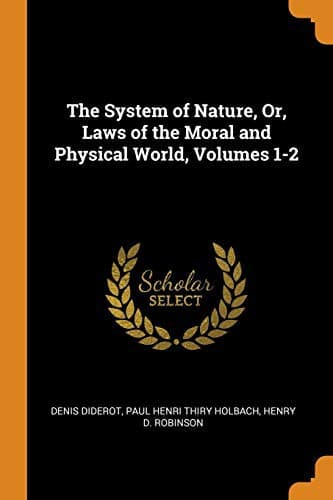
The System of Nature, or, the Laws of the Moral and Physical World. Volume 2Holbach, Paul Henri Thiry, baron d'
Religion
The System of Nature, or, the Laws of the Moral and Physical World. Volume 2
Holbach, Paul Henri Thiry, baron d'
Materialism; Philosophy and religion; Psychology
If, indeed, these irrational devotees only injure themselves, and
deprive society of that assistance which they owe to it, they without
doubt do less mischief than those turbulent, zealous fanatics, who,
infuriated with their superstitious ideas, believe themselves bound to
disturb the world, to commit actual crimes, to sustain the cause of
what they denominate the true faith. It not unfrequently happens that in
outraging morality, the zealous enthusiast supposes he renders himself
agreeable to his God. He makes perfection consist either in tormenting
himself, or in rending asunder, in favour of his fanatical ideas, the
most sacred ties that connect mortals with each other.
Let us, then, acknowledge, that the notions of superstition, are not
more suitable to procure the welfare, to establish the content, to
confirm the peace of individuals, than they are of the society of which
they are members. If some peaceable, honest, inconclusive enthusiasts,
find either comfort or consolation in them, there are millions who, more
conclusive to their principles, are unhappy during their whole life;
who are perpetually assailed by the most melancholy ideas; to whom their
disordered imagination shews these notions, as every instant involving
them in the most cruel punishments. Under such formidable systems, a
tranquil, sociable devotee, is a man who has not reasoned upon them.
In short, every thing serves to prove, that superstitious opinions have
the strongest influence over men; that they torment them unceasingly,
divide them from their dearest connections, inflame their minds, envenom
their passions, render them miserable without ever restraining their
actions, except when their own temperament proves too feeble to propel
them forward: all this holds forth one great lesson, that _superstition
is incompatible with liberty, and can never furnish good citizens_.
CHAP. IX.
_Theological Notions cannot be the Basis of Morality.--Comparison
between Theological Ethics and Natural Morality.--Theology prejudicial
to the human Mind._
Felicity is the great end of human existence; a supposition therefore,
to be actually useful to man, should render him happy. By what parity
of reasoning can he flatter himself that an hypothesis, which does not
facilitate his happiness in his present duration, may one day conduct
him to permanent bliss? If mortals only sigh, tremble, and groan in this
world, of which they have a knowledge, upon what foundation is it they
expect a more felicitous existence hereafter, in a world of which they
know nothing? If man is every where the child of calamity, the victim to
necessary evil, the unhappy sufferer under an immutable system, ought he
reasonably to indulge a greater confidence in future happiness?
Public-domain text, read in full here on John Shaqi.
Reviews
Reviews
No reviews yet
Be the first to share your thoughts on this work.
Elsewhere in the archive
Join the Discussion
Join the discussion
Sign in to leave a comment or review.
Sign InorCreate an account