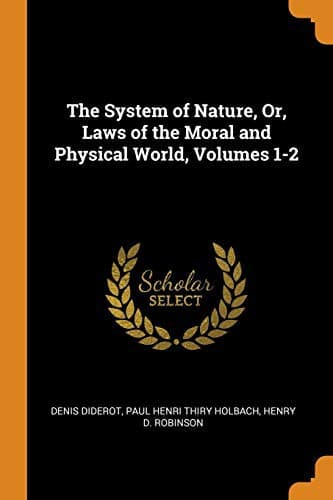
The System of Nature, or, the Laws of the Moral and Physical World. Volume 2Holbach, Paul Henri Thiry, baron d'
Religion
The System of Nature, or, the Laws of the Moral and Physical World. Volume 2
Holbach, Paul Henri Thiry, baron d'
Materialism; Philosophy and religion; Psychology
Whenever it is attempted to give any other basis to morality than the
nature of man, we shall always deceive ourselves; none other can have
the least stability; none can be more solid. Some authors, even of great
integrity, have thought, that to give ethics more respectability in the
eyes of man, to render more inviolable those duties which his nature
imposes on him, it was needful to clothe them with the authority of a
being whom they have made superior to nature--whom they have rendered
more powerful than necessity. Theology, seizing on these ideas, with its
own general want of just inference, has in consequence invaded morality;
has endeavoured to connect it with its various systems. By some it has
been imagined, this union would render virtue more sacred; that the fear
attached to invisible powers, who govern nature, would lend more weight,
would give more efficacy to its laws; in short, it has been believed
that man, persuaded, of the necessity of the moral system, seeing it
united with superstition, would contemplate superstition itself as
necessary to his happiness. Indeed it is the supposition that these
systems are essential to morality, that sustains the theological
ideas--that gives permanency to the greater part of all the creeds on
earth; it is erroneously imagined that without them man would neither
understand nor practise the duties he owes to others. This prejudice
once established, gives currency to the opinion that the vague ideas
growing out of these systems are in such a manner connected with
morality, are so linked with the actual welfare of society, that they
cannot be attacked without overturning the social duties that bind man
to his fellow. It is thought that the reciprocity of wants, the desire
of happiness, the evident interests of the community, would be mere
skeleton motives, devoid of all active energy, if they did not borrow
their substance from these various systems; if they were not invested
with the force derived from these numerous creeds; if they were not
clothed with the sanction of those ideas which have been made the
arbiters of all things.
Public-domain text, read in full here on John Shaqi.
Reviews
Reviews
No reviews yet
Be the first to share your thoughts on this work.
Elsewhere in the archive
Join the Discussion
Join the discussion
Sign in to leave a comment or review.
Sign InorCreate an account