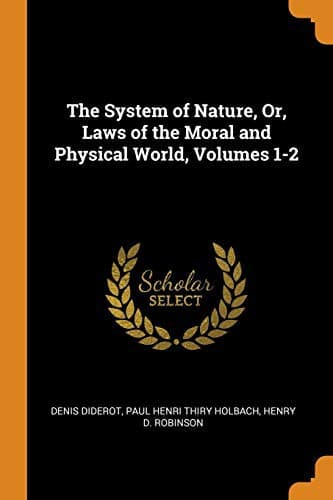
The System of Nature, or, the Laws of the Moral and Physical World. Volume 2Holbach, Paul Henri Thiry, baron d'
Religion
The System of Nature, or, the Laws of the Moral and Physical World. Volume 2
Holbach, Paul Henri Thiry, baron d'
Materialism; Philosophy and religion; Psychology
To say, that man cannot possess any moral sentiments without embracing
the discordant systems offered to his acceptance, is, in point of fact,
saying, that he cannot distinguish virtue from vice; it is to pretend
that without these systems, man would not feel the necessity of eating
to live, would not make the least distinction, would be absolutely
without choice in his food: it is to pretend, that unless he is fully
acquainted with the name, character, and qualities of the individual
who prepares a mess for him, he is not competent to discriminate whether
this mess be agreeable or disagreeable, good or bad. He who does not
feel himself satisfied what opinions to adopt, upon the foundation and
moral attributes of these systems, or who even formally denies them,
cannot at least doubt his own existence-his own functions--his own
qualities--his own mode of feeling--his own method of judging; neither
can he doubt the existence of other organized beings similar to himself;
in whom every thing discovers to him qualities analogous with his own;
of whom he can, by certain actions, either gain the love or incur the
hatred--secure the assistance or attract the ill-will--merit the esteem
or elicit the contempt; this knowledge is sufficient to enable him
to distinguish moral good and evil. In short, every man enjoying
a well-ordered organization, possessing the faculty of making true
experience, will only need to contemplate himself in order to discover
what he owes to others: his own nature will enlighten him much more
effectually upon his duties, than those systems in which he will consult
either his own unruly passions, those of some enthusiast, or those of
an impostor. He will allow, that to conserve himself, to secure his own
permanent welfare, he is frequently obliged to resist the blind impulse
of his own desires; that to conciliate the benevolence of others, he
must act in a mode conformable to their advantage; in reasoning thus,
he will find out what virtue actually is; if he puts his theory into
practice, he will be virtuous; he will be rewarded for his conduct by
the harmony of his own machine; by the legitimate esteem of himself,
confirmed by the good opinion of others, whose kindness he will have
secured: if he acts in a contrary mode, the trouble that will ensue, the
disorder of his frame, will quickly warn him that nature, thwarted by
his actions, disapproves his conduct, which is injurious to himself;
to which he will be obliged to add the condemnation of others, who will
hate him. If the wanderings of his mind prevent him from seeing the more
immediate consequences of his irregularities, neither will he perceive
the distant rewards, the remote punishments, which these systems
hold forth; because they will never speak to him so distinctly as his
conscience, which will either reward or punish him on the spot. Theology
has never yet known how to give a true definition of virtue: according
Public-domain text, read in full here on John Shaqi.
Reviews
Reviews
No reviews yet
Be the first to share your thoughts on this work.
Elsewhere in the archive
Join the Discussion
Join the discussion
Sign in to leave a comment or review.
Sign InorCreate an account